

Measure Before You Buy: Boot Shaft Heights and the ¼–1 in Fit Rule
Boot shaft height is the distance from the middle of the arch, where the sole meets the upper, straight up to the top edge of the shaft, and it never includes the heel. Before you buy, check two numbers on the product page: shaft height and shaft circumference, then compare both to your own leg measurements. Retailers like Macy’s and Timberland use this exact method, and some made-to-order brands build custom boots around it when standard sizing does not fit your leg.
TL;DR:
- Most standard boots measure shaft height from 3 to 18 inches, with taller shafts like over-the-knee extending past the knee for added coverage and warmth.
- Calf circumference is best measured at the fullest part, adding a quarter to one inch for comfort, especially if wearing thick socks or layered clothing.
- Choosing the correct shaft placement is crucial, as ends at the widest part of the calf can shorten the leg visually, while placements just above or below create a more balanced look.
- Retailers typically offer shaft circumferences up to around 16.5 inches, but custom sizing is necessary for calves wider than that or for precise fit needs.
- Primadonsanddonnas offers made-to-order boots with custom shaft height and circumference, ideal for fuller calves, non-standard leg lengths, and special occasions requiring exact fit.
Table of Contents
- How Do You Measure Boot Shaft Height?
- What Are the Standard Boot Shaft Height Categories?
- How Do You Measure Calf Circumference for a Comfortable Fit?
- Does Shaft Height Change How Your Legs Look?
- Which Shaft Height Fits Your Activity or Occasion?
- How Does Primadonsanddonnas Solve Common Shaft-Fit Problems?
- What Should You Check Before Buying Boots Online?
- How Should You Store Boots Based on Shaft Height?
- Where Can You Learn More or Shop Custom Boots?
- An Editorial Take on Getting Boot Shaft Fit Right
- Custom Boots Built Around Your Actual Measurements
- Sources
- FAQ
How Do You Measure Boot Shaft Height?
You can measure shaft height three ways: on a boot you already own, on your own leg, or by reading product specs correctly. Each method gets you closer to knowing exactly where a new boot will sit.
Measuring an existing boot: lay it flat, place a tape measure at the point where the sole meets the upper (the arch), and run it straight up the inside of the shaft to the top edge. Skip the heel entirely. If you own boots with an uneven shaft, measure both sides and average the result.
Measuring your own leg: stand naturally, then measure from the floor at your heel straight up the back of your leg to just below the kneecap. This tells you where a knee-high shaft would actually land, and it is the fastest way to catch a mismatch before you order.
Reading product specs online: confirm the listing states whether shaft height excludes the heel (most do, per Timberland’s own guidance), and look for a separate shaft circumference number. Larger shoe sizes often come with a slightly taller shaft, so a size 11 boot may sit an inch higher than the same style in a size 6, according to Macy’s fitting guide.
- Measure an existing pair from arch to shaft top, heel excluded.
- Measure your leg from heel to just below the kneecap.
- Cross-check the product page for shaft height, circumference, and heel-height notes.
Pro Tip: Measure both legs. Most people have a slight difference between left and right calf circumference, and it’s usually enough to change how a boot fits by the end of the day.
What Are the Standard Boot Shaft Height Categories?
Shaft heights fall into four widely used categories, and knowing the ranges saves you from guessing what “tall boot” actually means on a listing.
- Ankle/bootie: roughly 3 to 9 inches, sitting at or just above the ankle bone. Common for everyday wear and quick errands.
- Mid-calf: about 8 to 13.5 inches, landing somewhere between the ankle and the widest part of the calf. This range covers most fashion boots and a lot of work boots too.
- Knee-high/tall: around 13.5 to 18 inches, reaching the knee or just below it.
- Over-the-knee: 18 inches and up, extending past the knee toward the thigh.
Work-boot brands often skip the category labels and list a single number instead. Thorogood publishes common shaft heights of 6, 8, 9, 10, 11, 12, and 14 inches, with taller shafts built for more ankle protection and insulation. Keep in mind that shaft length shifts slightly with shoe size, so the same style might measure half an inch taller in a size 10 than in a size 7.
How Do You Measure Calf Circumference for a Comfortable Fit?
Shaft circumference matters as much as height, and it’s the number most first-time boot shoppers skip. Find the fullest part of your calf, usually a few inches below the knee, and wrap the tape measure around it parallel to the floor. Don’t pull it tight; you want a relaxed, accurate reading.
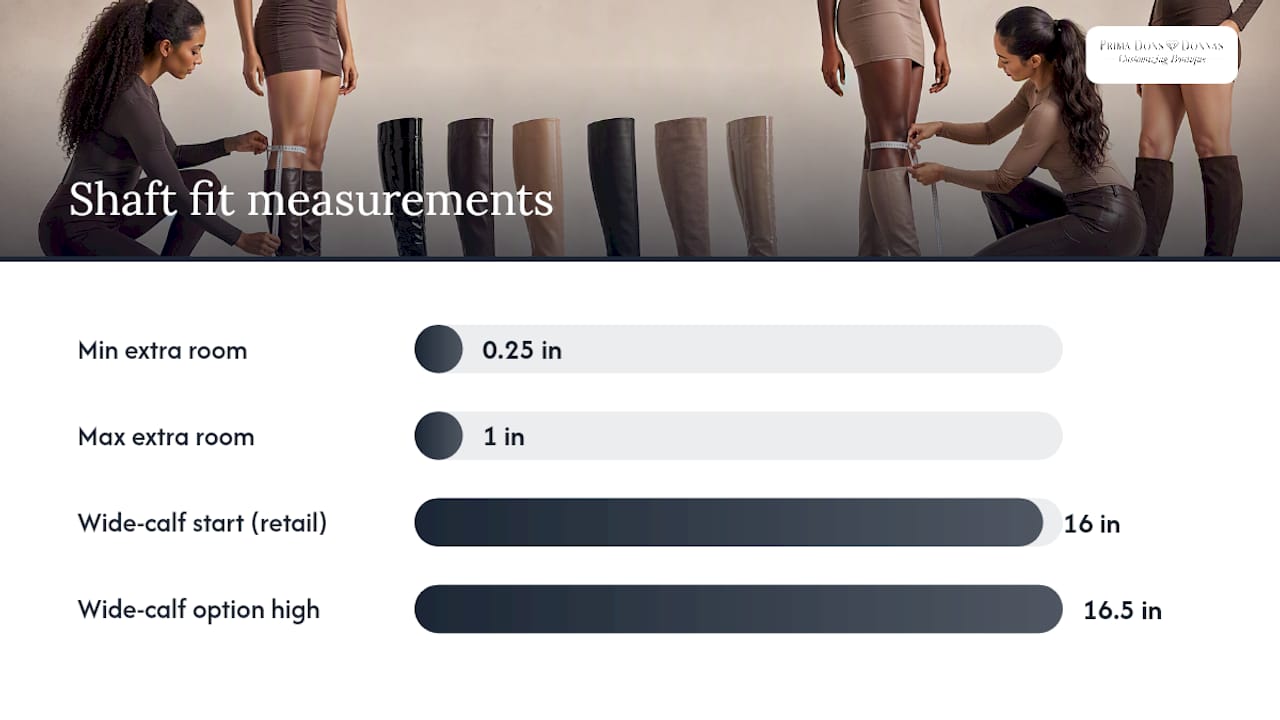
Once you have that number, add room for comfort. WikiHow’s measurement guide recommends a shaft circumference about a quarter inch to a full inch larger than your calf measurement, with some stretch materials allowing a slightly tighter fit without discomfort.
- Choose the higher end of that range (closer to 1 inch) if you plan to wear thick socks, layer leggings underneath, or have a fuller calf.
- Choose the lower end (closer to a quarter inch) for boots you’ll wear with thin tights or bare legs.
- Look for stretch panels, elastic gussets, or side laces if you fall between standard sizes.
Retailers including DSW list wide-calf options starting around 16 to 16.5 inches in circumference. If your measurement sits above what a brand offers, or you want a shaft that hits at an exact spot on your leg, a made-to-order option removes the guesswork entirely.
Pro Tip: If a boot’s shaft circumference sits right at your calf measurement with zero extra room, size up or ask about a stretch panel. A shaft with no give tends to leave marks by the end of the night.
Does Shaft Height Change How Your Legs Look?
Shaft height changes your leg line more than most shoppers expect, and getting it wrong can make even a great boot feel off. The general rule: avoid a shaft that ends exactly at the widest part of your calf. That placement tends to visually shorten the leg and draw attention to the fullest point rather than smoothing past it. A shaft that hits just above or just below the widest part of the calf almost always looks more balanced.
- Petite frames often do well with ankle or mid-calf boots paired with a slight heel, which keeps proportions from getting overwhelmed by too much shaft.
- Average and taller frames can carry knee-high or over-the-knee styles without the leg looking cut short.
- Heel height interacts with shaft height too. A higher heel elongates the leg enough to make a mid-calf boot read taller than it is.
- Taller shafts add warmth and coverage for outdoor wear; shorter shafts trade that protection for easier movement and more outfit flexibility.
None of this is about a single “correct” height. It’s about matching shaft placement to your own leg shape and to what the boot needs to do that day.
Which Shaft Height Fits Your Activity or Occasion?
Matching shaft height to purpose keeps you from choosing a boot that looks right in a photo but fails you three hours into wearing it.
For work environments, OSHA treats protective footwear as personal protective equipment in settings that call for it, which is why mid-height and tall work boots exist in specific inch increments rather than fashion categories. Riding and outdoor activities favor taller shafts for the same reason: more coverage against brush, stirrups, or cold, with pull-on styles for quick changes and lace-up styles for a locked-in fit.
Social occasions run the other direction. Ankle and mid-calf boots pair easily with jeans or a dress for a concert or a lunch date, while knee-high and over-the-knee styles make more of a statement for parties, photoshoots, or wedding-guest outfits.
- Decide the purpose: work, outdoor activity, or social occasion.
- Measure your calf circumference.
- Compare that number and your leg measurement to the product’s listed specs.
- Adjust for heel height and sock thickness before finalizing your size.
How Does Primadonsanddonnas Solve Common Shaft-Fit Problems?
Standard sizing assumes one calf circumference per shoe size, which leaves a lot of shoppers stuck between too tight and too loose. Primadonsanddonnas builds boots to order, which means shaft height and shaft circumference get set to your actual measurements instead of a factory average.
That matters most for readers with a fuller calf, a shorter or longer leg than average, or a specific look in mind for a wedding, a birthday shoot, or a night out. A custom thigh-high boot built to your measurements sits exactly where you want it, not wherever the mold happened to land.
- Made-to-order shaft height and circumference for a fit that matches your leg, not a size chart average.
- Plus-size and wide-calf options built into the thigh-high and wide-calf collection rather than offered as a limited add-on.
- Styling flexibility for special-occasion outfits where shaft placement affects the whole silhouette.
Shoppers who need a wide-calf fit routinely find standard boots stop around the 16 inch circumference mark, per DSW’s sizing data, which is exactly where custom sizing starts to matter most.
What Should You Check Before Buying Boots Online?
A short checklist catches most fit problems before they become a return shipment.
Require these four details on any product page: shaft height, shaft circumference, heel height, and confirmation that the shaft measurement excludes the heel. If a listing is missing any of these, treat it as a red flag rather than an oversight.
- Measure both of your legs, not just one.
- Measure a boot you already own and compare it to the new listing.
- Match your calf circumference to the product’s shaft circumference, allowing a quarter inch to a full inch of extra room.
- Walk away from listings with no circumference number or no clear explanation of how they measured shaft height.
Pro Tip: If customer photos show the shaft gapping at the top or pinching at the calf, that’s real feedback about fit, not just style. Read a few before you order.
How Should You Store Boots Based on Shaft Height?
Shaft height decides how a boot needs to be stored, and getting it wrong is one of the fastest ways to ruin a good pair. Tall shafts, whether knee-high or over-the-knee, are prone to creasing, slumping, and losing their shape if left standing unsupported in a closet. That slouch isn’t just cosmetic on structured styles. It can permanently weaken the material along the fold line.
How to store over-the-knee boots: use boot shapers or rolled-up magazines, pool noodles, or dedicated inserts inside the shaft to keep it upright. Store them standing, not folded, and never stack anything heavy on top of the shaft.
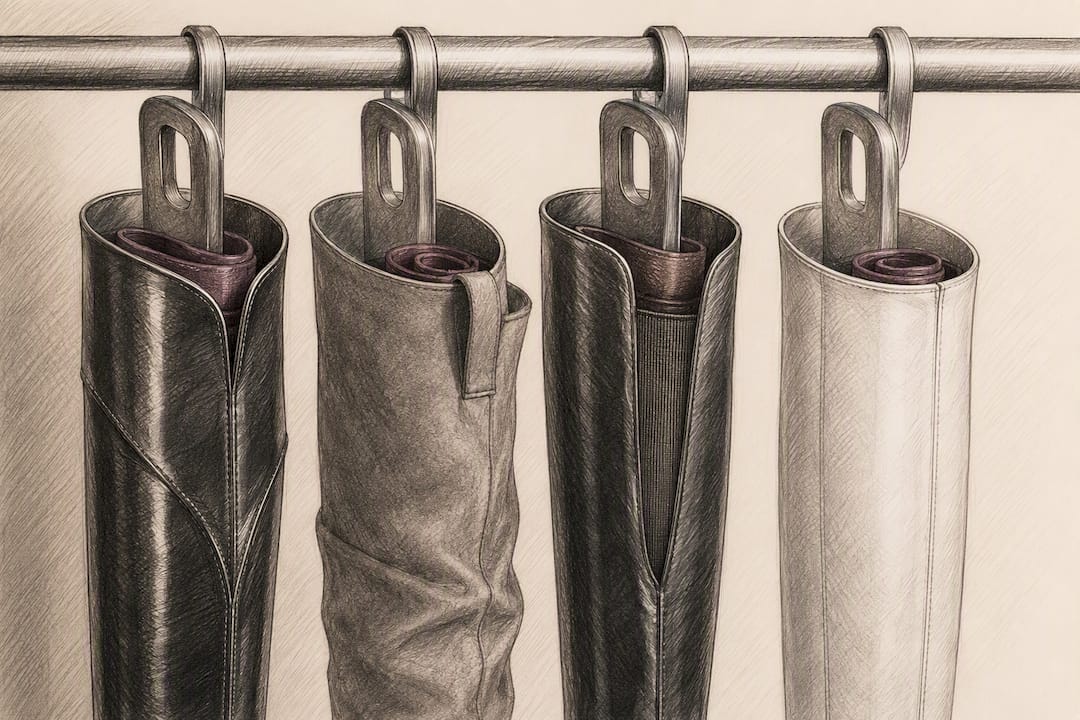
How to store thigh-high boots: the same upright approach applies, but thigh-high shafts benefit from a boot hanger or a clip system that keeps the full shaft extended so faux leather or suede doesn’t develop a permanent crease at the widest bend point.
Store knee-high boots the same way when possible, though their shorter shaft makes them more forgiving. A slight fold near the ankle is less likely to leave a lasting mark than the same fold higher up a taller shaft.
Ankle boots and booties need far less intervention since there’s little shaft to collapse. Stuff the toe box to hold shape, and keep them away from direct sunlight if they’re a lighter material. For any tall-shaft boot, rigid materials like structured faux leather hold their form better in storage than soft, flexible fabrics, which is worth factoring in if you’re choosing between two similar styles.
Where Can You Learn More or Shop Custom Boots?
- Macy’s boot fitting guide and Timberland’s measuring FAQ for measurement basics.
- DSW’s sizing guide and Thorogood’s shaft guide for wide-calf and work-boot specifics.
- Shop the Prima Dons and Donnas boots collection for custom and plus-size shaft options.
An Editorial Take on Getting Boot Shaft Fit Right
Most boot buying guides treat shaft height like a style category. It’s not. It’s a measurement problem first, and the fashion decision only makes sense once that measurement problem is solved. The industry ranges (ankle, mid-calf, knee-high, over-the-knee) are useful shorthand, but they hide a wide amount of variation inside each category. A “knee-high” boot at 13.5 inches and one at 18 inches will fit two different bodies completely differently, even though a size chart lists them under the same word.
Where conventional advice falls short is the circumference conversation. Shoppers get told to check shaft height and stop there, when circumference is what actually causes the pinching, gapping, or slouching that leads to returns. The quarter-inch-to-one-inch allowance guideline is small on paper but massive in practice.
If you take one thing from this, prioritize your calf measurement before you fall in love with a style photo. A boot that fits your leg will always look better than a boot that only fits the mannequin.
— Latoya
Custom Boots Built Around Your Actual Measurements
Primadonsanddonnas is the option for shoppers who’ve measured their calf, checked three product pages, and still can’t find a shaft that fits right. Instead of choosing between “too tight” and “too loose” on a standard size chart, you get shaft height and shaft circumference built to your own numbers, whether that’s for a wide calf, a petite leg, or an exact placement you want for a special occasion.

That flexibility matters most when the boots need to do double duty, like showing up in wedding photos, working through a concert, or anchoring a party outfit you’ve already planned around a specific hemline. Browse the thigh-high and wide-calf boot collection to see current styles, or pair a custom pair with a piece from the made-to-order dress collection for a full outfit built to your measurements from top to bottom. Start with your calf circumference and go from there.
Sources
- Boot Fitting Guide | Macy’s
- How to measure boots | Timberland
- How to Measure a Boot Shaft | wikiHow
- Boots sizing guide | DSW
- How to measure a boot shaft | Thorogood USA
FAQ
Is Boot Height the Same as Shaft Height?
Not quite. “Boot height” is often used loosely to describe overall boot size, while “shaft height” specifically refers to the measurement from the arch to the top edge of the shaft, excluding the heel.
What Boots Have a 12-Inch Shaft Height?
Work boots most commonly list a 12 inch shaft height as a standard option, alongside 6, 8, 9, 10, 11, and 14 inch heights, according to Thorogood’s sizing data. That height typically lands mid-calf to just below the knee, depending on leg length.
How Do You Measure Your Shaft Height for Boots?
Measure from the point where your heel meets the floor straight up the back of your leg to just below your kneecap for a knee-high reference point, or measure an existing boot from the arch to the top of the shaft, excluding the heel.
How Do You Calculate Shaft Height?
Shaft height is a direct measurement, not a calculation: place a tape measure at the arch where the sole meets the upper, and run it straight to the top of the shaft, leaving the heel out of the total.
What If My Calf Doesn’t Match Any Standard Shaft Circumference?
Standard sizing tops out around 16 to 16.5 inches of calf circumference at most retailers, per DSW’s guide, so a custom option like those from Primadonsanddonnas is often the most reliable path to a boot that actually fits.


Leave a comment