

Avoid a $3,200 Surprise: Custom Dress Costs for Brides
Most custom dresses run between $1,500 and $5,500, with simple made-to-order pieces starting lower and heavily beaded or couture gowns climbing past $9,000. That range usually includes fittings and construction, which is exactly what off-the-rack pricing leaves out. If you want a predictable total instead of a surprise alterations bill, custom is often the smarter budget move, not just the fancier one.
TL;DR:
- Custom dress prices generally start at $1,500 for simple designs and can exceed $9,000 for heavily beaded or couture gowns, including fittings and construction.
- Labor costs, especially handwork like beading and embroidery, are the main drivers of price, while fabric choice and fittings also significantly affect the total.
- Embellishments, pattern drafting, number of fittings, and rush fees can quickly increase costs beyond initial quotes, so early planning is essential.
- Off-the-rack dresses often seem cheaper initially but can incur high alteration costs, making custom pricing more predictable if fittings are included upfront.
- Starting consultations six to nine months in advance and thoroughly clarifying what’s included in quotes can prevent budget surprises.
Table of Contents
- How Much Does a Custom Dress Cost?
- What Actually Drives Custom Dress Price?
- How Long Does a Custom Dress Take to Make?
- Custom Dress Cost vs. Off-the-Rack: Which Wins?
- What to Ask a Designer Before You Commit
- The Hidden Fees That Inflate a Custom Dress Quote
- How Prima Dons and Donnas Prices Made-to-Order Dresses
- Why Most Cost Guides Get Custom Dresses Wrong
- Ready to Start Your Custom Dress Order?
- Sources
- FAQ
How Much Does a Custom Dress Cost?
The custom dress cost conversation almost always starts with wedding gowns, since that’s where the biggest budgets and the widest price swings show up. But the same tiers apply to formal event dresses, prom looks, and special-occasion pieces. Here’s how the market typically breaks down.
- Entry/made-to-order: Simple silhouettes with standard fabrics, minimal embellishment, and a straightforward pattern often start around $1,500. This tier skips complex handwork, so labor hours stay low.
- Mid-range custom: Most buyers land in the $2,000 to $5,500 band, according to designer surveys compiled by The Knot. This covers a well-constructed gown with some beading, a lined bodice, or a custom color, without full couture handwork.
- Couture and heavy embellishment: Fully beaded bodices, hand embroidery, boning, or rare fabrics push costs well above $9,000, since every extra hour of hand-sewing adds directly to the labor bill.
Geography and atelier reputation shift these numbers too. A dressmaker working solo from a home studio charges differently than a bridal house with a storefront, a design team, and in-house fitters. Neither is automatically better, but the price gap between them is real, and it’s worth asking what that gap buys you before you sign anything.
What Actually Drives Custom Dress Price?
Fabric is the most visible cost driver, but it’s rarely the biggest one. Silk mikado, French lace, and hand-beaded appliqué cost more per yard than polyester satin, and a fuller skirt simply eats more yardage. Still, labor usually outweighs materials on a final invoice.
Here’s what typically moves the needle, in rough order of impact:
- Labor hours for handwork. Hand beading, embroidery, and boned corsetry take hours per inch, not per garment, which is why heavily embellished gowns cost so much more than clean, simple ones.
- Pattern drafting and prototyping. A dress built from a custom pattern, sometimes tested first in a muslin toile, requires design time that a standard-size pattern skips entirely.
- Number of fittings. Two fittings cost less than four. Every extra session means the designer sets aside time, pins, adjusts, and often re-stitches sections.
- Trims and hardware. Boning channels, zippers, corset lacing, and structural underlays add both material and construction time.
- Rush fees and shipping. Compressed timelines mean a designer reshuffles their whole schedule to fit you in, and that cost gets passed along.
Pro Tip: Lock in your silhouette and any nonnegotiable details (neckline, sleeve style, train length) before your first fitting. Changing your mind mid-process often means redoing patterning work you already paid for, which is one of the fastest ways to blow past your budget without adding anything to the final look.
How Long Does a Custom Dress Take to Make?
Made-to-order shipping time varies a lot depending on how much of the dress is truly custom versus adjusted from an existing pattern. Fully bespoke work, where every element is drafted from scratch, takes the longest and gives you the most room to request changes along the way.
These bands come from bridal timeline data compiled by Azazie, and designers generally recommend starting consultations six to nine months out for bespoke pieces, earlier if you’re working with rare fabric or intricate handwork. Rush processing compresses these windows, but it also narrows your change window and adds fees. Build in a two to four week delivery buffer before your event date to absorb shipping delays or a final fitting adjustment.
Custom Dress Cost vs. Off-the-Rack: Which Wins?
Off-the-rack dresses look cheaper at checkout, but alterations change that fast. Standard alteration work runs anywhere from $200 to $3,000 depending on how much the dress needs to change, according to pricing data from Maki Fashion. A $900 sample-size gown that needs a full bodice resize, hem, and strap rebuild can quietly turn into a $2,500 project.
Custom pricing, when it includes fittings up front, avoids that surprise entirely, since the fit is built in from the start rather than corrected after the fact.
One in three brides underestimates alteration costs when comparing off-the-rack prices to custom quotes, largely because retail price tags never show what the tailor bill will add later.
Before you compare two numbers side by side, confirm what each one actually includes:
- Does the quote cover fittings, or are those billed separately?
- Are shipping, rush fees, and local finishing included, or added later?
- Is there a cancellation or refund policy if your plans change?
A simple budgeting rule: take any custom quote and add 10% to 20% as a contingency for shipping, a possible rush fee, or a last-minute change. That buffer usually covers it without derailing your total.
What to Ask a Designer Before You Commit
A vague quote is the number one reason custom dress budgets spiral. Before you put down a deposit, get clear answers on these points.
- What’s included in the base price? Ask specifically whether fittings, alterations, and finishing are bundled or billed as extras.
- What’s the fitting policy? Some designers include two fittings; others charge per session after the first.
- What triggers a rush fee? Get the exact cutoff date after which rush pricing kicks in.
- Who covers shipping and insurance? Confirm whether that cost is built in or added at checkout.
- What’s the cancellation policy? Deposits on custom work are often nonrefundable once cutting begins, so know that before you sign.
Design choices can also lower cost without gutting the look you want. Swapping hand beading for machine-appliquéd lace, choosing a simpler back closure, or picking a fabric that doesn’t fray easily can all shave hours off labor time.
Pro Tip: Batch your change requests into one round instead of emailing new ideas every few days. Designers charge for repeated pattern adjustments, and consolidating feedback into a single, thorough fitting note usually keeps your final bill closer to the original quote.
Watch for open-ended language in a quote, phrases like “pricing may vary” with no explanation of what causes the variance. A designer who can’t tell you what triggers an extra charge probably can’t tell you your final total either.
The Hidden Fees That Inflate a Custom Dress Quote
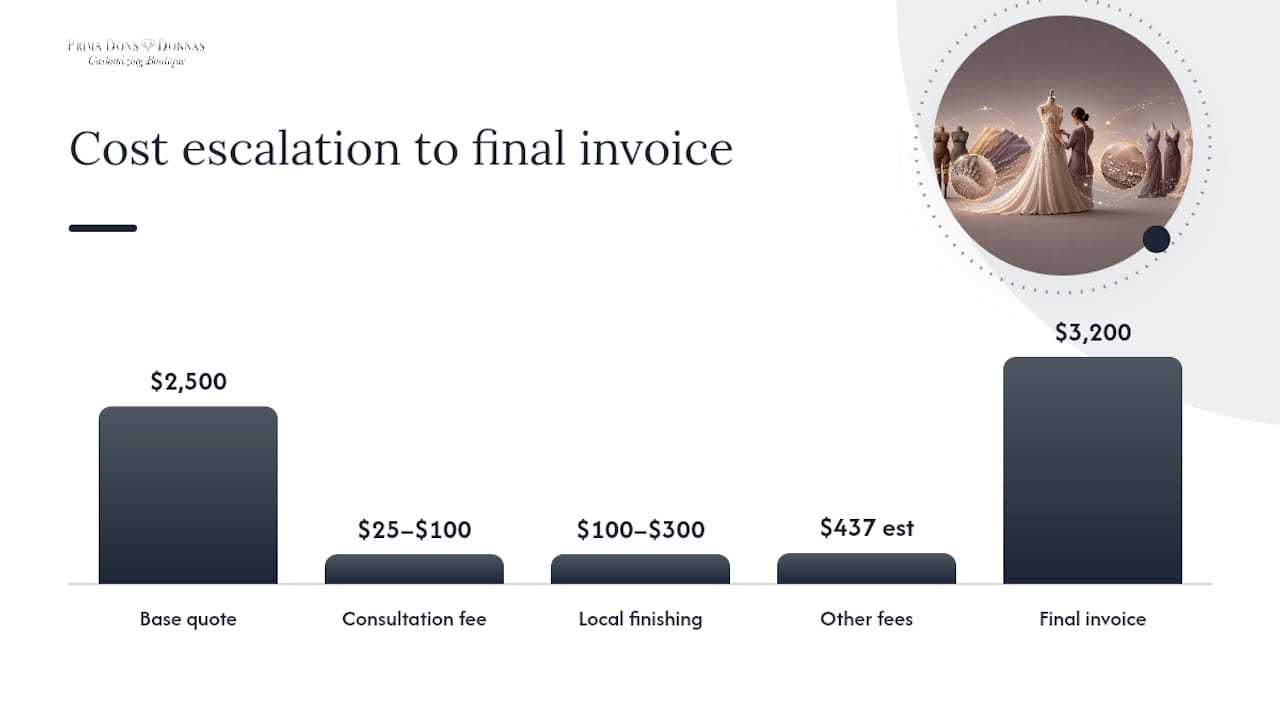
The sticker price on a custom dress rarely tells the whole story. Consultation fees are one of the first surprises: some designers charge $25 to $100 just to sit down and discuss your vision, though many waive it once you book. Ask upfront whether that fee applies toward your final balance or disappears entirely.
Cancellation policies deserve close attention too. Once a designer cuts fabric or begins patterning, most treat deposits as nonrefundable, and some charge a percentage of the total price if you cancel mid-process. Read this section of any contract before you sign, not after.
Shipping and local finishing are the other quiet cost additions. Some ateliers ship a fully finished, ready-to-wear gown. Others send the dress mostly complete and expect you to pay a local tailor for a final hem or fit adjustment, according to reporting from The Knot. That distinction alone can add another $100 to $300 you didn’t budget for.
Rush fees, insurance, and signature confirmation on delivery round out the list. None of these are dealbreakers, but they’re exactly the kind of line items that turn a $2,500 quote into a $3,200 final invoice if nobody flags them early. Ask for a full, itemized breakdown before you commit, not a lump sum.
How Prima Dons and Donnas Prices Made-to-Order Dresses
Made-to-order pieces are often built around your actual size and color choice, with inclusive sizing that covers plus sizes without up charging them as an afterthought. Custom dress collections often work alongside customization options like rush processing for tighter timelines, and ready-to-ship lines exist for shoppers who can’t wait out a made-to-order schedule. Pricing details for styles typically live directly on product pages, so what you see reflects what you might expect to pay.
Why Most Cost Guides Get Custom Dresses Wrong
Most advice on custom dress cost treats the sticker price as the whole story, comparing a $1,800 custom quote against a $900 off-the-rack gown and calling the second one the deal. That comparison almost always ignores the alteration bill waiting on the other side of the off-the-rack purchase, and it treats “custom” as a single price point instead of a spectrum that runs from simple made-to-order pieces to full couture.
The bigger blind spot is timeline. Shoppers fixate on the dollar figure and forget that a rushed custom order costs more in fees and gives up the design flexibility that makes custom worth choosing in the first place. If you start the process eight months out, you get more input, more fitting rounds, and a calmer budget. Start six weeks out, and you’re paying rush fees for a fraction of the say in how the dress turns out.
Custom dress cost isn’t really about spending more. It’s about paying for the parts of the process, fit, fabric choice, and construction, that off-the-rack pricing quietly outsources to your local tailor later. Once you see the full total on both sides, custom starts looking less like an indulgence and more like the version with fewer unknowns.
— Latoya
Ready to Start Your Custom Dress Order?
Skip the guesswork of comparing vague quotes from multiple ateliers. Prima Dons and Donnas builds every piece to your exact size and color, so the price you see for a style already reflects a garment made for your measurements, not a sample block you’ll pay someone else to fix later.

Start by browsing the Custom Made to Order Dress Collection to find a silhouette that fits your event, whether that’s a wedding, a formal dinner, or a night out. If your timeline is tight, check customization options for rush processing and express shipping add-ons, or look at the Ready to Ship line if you need something in hand fast. Before you order, jot down your size, color preference, and event date, then reach out with those details so your quote is accurate from the first message. For a full walkthrough of what to prepare, the checklist for ordering custom dresses covers exactly that.
Sources
- How Much Does a Custom Wedding Dress Cost? Experts Weigh In — The Knot
- How Much Does a Custom Wedding Dress Cost? — Maki Fashion
FAQ
How Much Does It Cost to Have a Custom Dress Made?
Most custom dresses cost between $1,500 and $5,500, with simple made-to-order styles at the lower end and heavily beaded or couture gowns exceeding $9,000, according to The Knot.
How Much Does a Custom Dress Form Cost?
A dress form built to your exact measurements is a separate service from a custom garment and isn’t part of standard made-to-order dress pricing; check with your specific pattern-maker for that cost.
How Much Does It Cost to Get Custom Clothes Made?
Costs vary widely by garment type, fabric, and labor complexity, but a simple custom piece often starts near $1,500, while heavily detailed or couture work climbs well past $9,000.
Is $2,000 Reasonable for a Wedding Dress?
Yes. $2,000 sits comfortably in the mid-range custom band most designers report, and it can cover a well-constructed gown with some embellishment, especially when fittings are included in that price.


Leave a comment