

Faux Fur Quality: How to Tell Good From Great
Good faux fur has a dense, soft pile that springs back after you touch it. It sits on a firm backing, and the seams and lining are finished with care. You can check most of this with your hands in under a minute. This guide shows what to feel for, what the fiber type changes, how to care for the piece, and where made-to-order faux fur fits in.
TL;DR
- Quality comes from the fibers: soft, glossy, springy pile that bounces back after you press it.
- Density matters, but too dense feels stiff. Look for a pile that does not part to show the backing.
- Turn the piece over. The backing should be firm and on-grain, and the lining soft and well sewn.
- Acrylic and modacrylic blends are common in good faux fur because they are soft and resilient.
- Keep heat and water away, brush gently, and store it properly so the pile stays full.
Table of Contents
- What “quality” means in faux fur
- Check the pile: density, softness and recovery
- Turn it over: backing, lining and seams
- Fiber type: what the label tells you
- Weight and GSM: a number worth knowing
- A 60-second quality checklist
- Real fur or faux: a quick identification test
- Care that keeps quality high
- Why quality is also the sustainable choice
- Choosing faux fur for the occasion
- Where made-to-order fits in
- Shop faux fur at Prima Dons and Donnas
- Perspective
- FAQ
- Sources
What “quality” means in faux fur
Faux fur is built in layers. Synthetic fibers are attached to a backing, usually knitted, and many coats add a lining on the inside. According to the Los Angeles Times, fiber quality makes the biggest difference in how fake fur looks and feels. A design director quoted there names two traits of high-quality fake fur: softness and resilience, meaning the fibers bounce back after being touched.
So “quality” is not one number. It is a handful of things you can judge: the pile, the backing, the fiber type, the lining and the construction. The sections below take them one at a time.
Check the pile: density, softness and recovery
The pile is the fur part you see and touch. Three checks cover it.
Density. Part the pile with your fingers. A dense pile closes back over the backing. University of Idaho Extension guidance recommends a dense pile that is uniform in luster and texture and does not part to show the backing. South Dakota State University Extension makes the same point: better-quality fake furs have a dense, close pile and a firm backing.

More is not always better. The Los Angeles Times piece notes that higher fiber density usually means higher quality, but too many fibers per square inch can make a garment unpleasantly stiff. You want full and plush, not packed and board-like.
Softness and sheen. A designer interviewed by Forbes looks for a silky smooth hand feel and a glossy sheen. She also looks for fibers of different lengths, which give the fur a believable, natural look. Poor-quality synthetic fur can feel itchy.
Recovery. Press your palm into the pile and lift. Good fibers spring back fast. Brush the pile with your fingers and see if it settles into place. University of Idaho guidance also suggests rubbing the pile to see whether it mats or pills.
Turn it over: backing, lining and seams
Most shoppers only look at the fur side. The back tells you more about how the piece will wear.
- Backing. Reverse the fur. University of Idaho Extension says the backing should be firm but not stiff or board-like, on-grain, and not easily stretched.
- Warmth. The same guide says the number and closeness of yarns in the backing, plus pile density, are the best indicators of warmth. Layered pile is generally warmer than single-length pile. Pile length alone is a poor guide.
- Lining. A good lining is smooth, sewn in neatly and strong enough to protect the seams from friction. Check that it is attached evenly, with no puckering.
- Seams. Look along the seams and closures. Well-made pieces have reinforced seams, and the pile near the stitching looks full rather than flattened.
A quick tuft test helps too. Give a few fibers a light tug. A couple of loose strands is normal. A clump coming away is a sign of weak fiber anchoring.
Fiber type: what the label tells you
Read the fiber content label before you fall for the look. Faux fur is manmade. South Dakota State University lists acrylic, modacrylic, rayon and polypropylene as the fibers used, and describes these fabrics as durable, mothproof and mildew resistant.
University of Idaho Extension explains why acrylic, modacrylic and blends are so common: they are soft, resilient, easily cleaned and fur-like. It adds that modacrylic offers inherent flame resistance. For flame-resistant fake furs, look for a flame-resistant finish noted on the label, modacrylic content, or a short pile.
Blends also separate “fun” fur from “luxury” fur. A fashion-fabrics buyer quoted in The Guardian describes fun fur as a polyester and modacrylic mix. She describes luxury fur as an acrylic and polyester mix with a longer, deeper pile. The same article says a faux fur coat can potentially last for decades.
If you sew or customize, our guide to pile lengths and fibers for faux fur projects goes deeper on matching fiber to the piece you want.
Weight and GSM: a number worth knowing
GSM means grams per square meter. It measures how much fiber and fabric sits in a given area, so it is a rough guide to how heavy and plush a faux fur is. A Wirecutter review quotes a FIT home products professor saying faux fur quality comes down to fiber GSM. In that review, a blanket near 1,090 GSM was placed at the higher end of the category.
GSM is a useful number when a product page lists it. When it does not, your hands do the same job: a heavier, denser fur feels substantial, drapes with weight and does not show the backing when you part it.
A 60-second quality checklist
| Check | Good sign | What to avoid |
|---|---|---|
| Pile density | Closes over the backing when parted | Backing shows through easily |
| Softness | Silky, glossy, no itch | Rough or scratchy feel |
| Recovery | Springs back after pressing | Fibers stay flat or clump |
| Backing | Firm, on-grain, little stretch | Floppy, stretchy or board-stiff |
| Lining | Soft, neatly sewn, strong | Loose, puckered or thin |
| Seams | Pile brushed out of stitching | Flat visible seam lines |
| Shedding | A few loose fibers at most | Clumps on your hands |
Real fur or faux: a quick identification test
If a piece is unlabeled, look at the base. Forbes explains that leather or skin at the base means real fur, while faux fur has a fabric backing. Natural animal hair tapers at the tips, and faux fibers have blunter, straighter edges.
Care that keeps quality high
A well-made piece stays well-made when you look after it. Faux fur fibers are very heat sensitive. South Dakota State University notes these fabrics are very heat sensitive and subject to static electricity. So keep hair dryers, radiators, irons and hot dryer cycles away from your piece.
The Guardian article gives a dry cleaner’s routine for a coat you wear regularly:
- Keep it away from water, which she says permanently damages faux fur fibers.
- Brush it weekly in the direction of the fur.
- Dry-clean it every six to eight weeks with a special texture solvent if you wear it regularly.
Store the piece on a wide, padded hanger in a breathable garment bag so the pile does not get crushed. Our faux fur care guide covers cleaning, drying and storing step by step, and our storage guide covers keeping pieces fresh between seasons.
Why quality is also the sustainable choice
A faux fur piece that holds its shape gets worn for many seasons. That is the simplest sustainability move you can make: buy something you will keep. A well-built coat you love for ten winters beats three cheap ones that mat and shed.
If you want to go further on materials, read our guides to sustainable fashion materials for 2026 and sustainable fashion options for conscious women. For the bigger comparison, see faux fur vs real fur.
Choosing faux fur for the occasion
The right fur depends on where you will wear it. Here is how we would match them.
- Birthday photoshoot or night out. Choose a fuller, longer pile that photographs with volume. Pick a color that stands out against your outfit.
- Concert or party. A cropped jacket or stole gives the statement look without bulk. A lining that moves easily helps in a crowd.
- Lunch date. A shorter, sleeker pile reads polished and keeps the look easy.
- Winter wedding. A faux fur wrap or jacket over a dress adds warmth and finish.
- Plus size. Fit matters most in outerwear. You need room through the shoulders and arms for layers, and sleeves that reach the wrist.
Where made-to-order fits in
Off-the-rack faux fur comes in set sizes and a limited set of colors. A made-to-order piece changes that. You pick the garment, the size and the color, so the fur you choose can match the exact look you are building. That is also how you avoid the most common quality complaint, which is a coat that looks great on the hanger and fits badly on you.
Our Custom Outerwear Collection offers made-to-order pieces in any size or color. Our faux fur and leather coats, jackets and boots page shows the fur styles we have available. If you want the idea behind customization first, read how to customize faux fur for a unique, sustainable look.
Shop faux fur at Prima Dons and Donnas
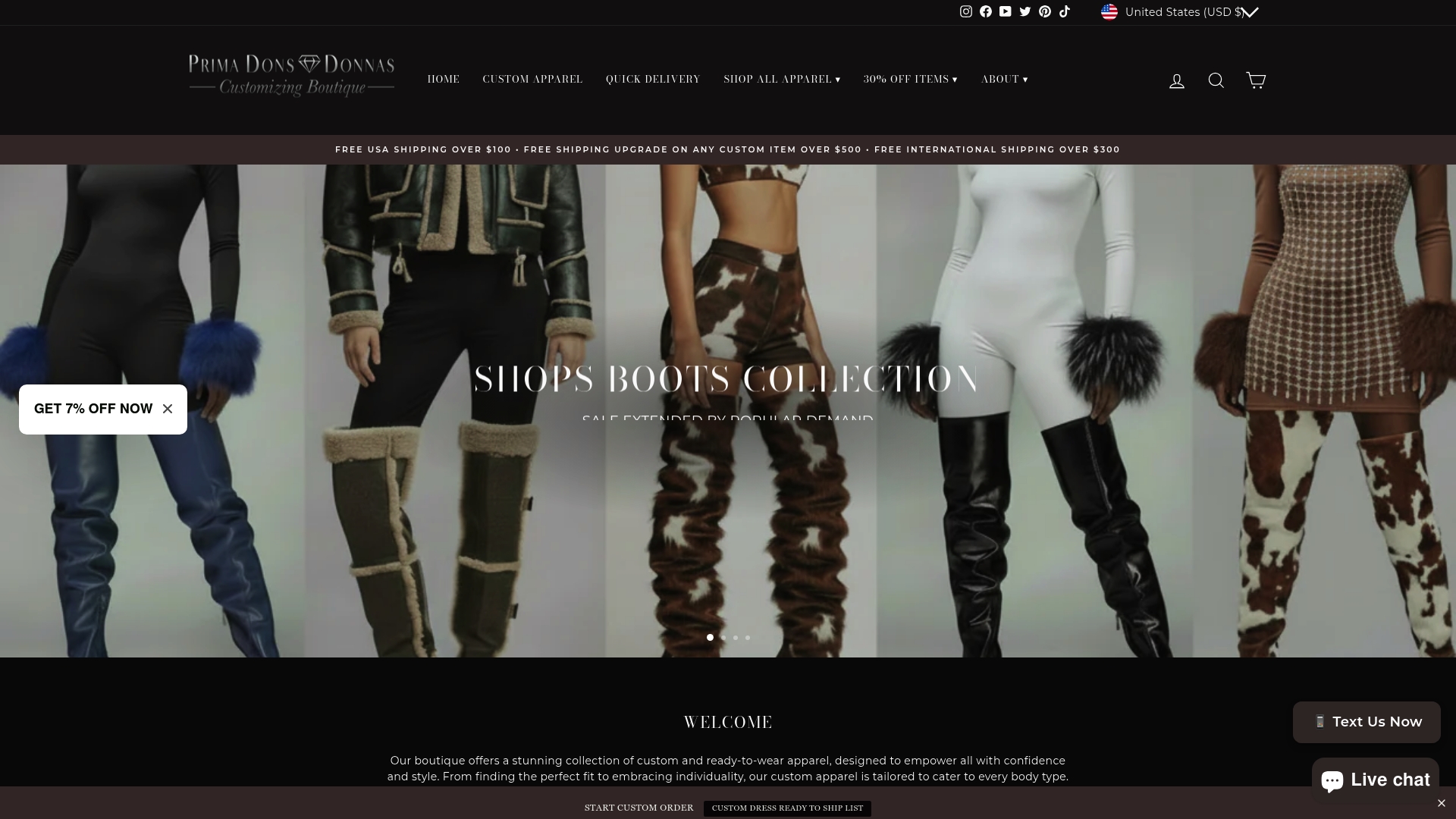
We make custom clothing and footwear for women in any size or color, including plus sizes, and we use high-quality faux fur for conscious fashion choices. Browse the Fur Collection and Wedding and Prom pieces for statement looks. If you need it fast, the Ready to Ship collection has options that arrive quickly.
For made-to-order pieces on a deadline, the customization options page lists Express Shipping at $103 and a Rush Processing Add-On at $128. Shipping Insurance and Signature Confirmation are $4 each.
Perspective
We design for women who want to be seen. Faux fur is the clearest way to do that: it is bold, soft and photographs beautifully. But a statement piece only works if it fits and holds up.
That is why we offer made-to-order faux fur in any size or color. Fit and color are the two things most shoppers cannot find off the rack, especially in plus sizes. When a piece is made for your measurements, the fur sits the way it should, and you wear it more often.
Wearing a piece more often is also the most practical form of sustainability. We want you to pick a faux fur you love, look after it with a soft brush and a good hanger, and bring it out every season.
Latoya
FAQ
Is faux fur high quality?
It can be. Quality depends on the fibers, the pile density, the backing and the finishing. Soft, springy fibers on a firm backing with a neat lining make a piece that looks good and lasts for many seasons.
How can you tell good-quality faux fur?
Part the pile and check that the backing does not show. Press it and see whether it springs back. Turn it over to feel for a firm, on-grain backing, and check that the lining is soft and the seams are neat.
What is the best quality faux fur?
Look for acrylic or modacrylic blends with a dense, soft, glossy pile and fibers of varying lengths. Heavier, denser faux furs usually feel more luxurious, as long as they stay supple rather than stiff.
How do I keep faux fur looking new?
Keep it away from heat and water. Brush it gently in the direction of the fur, and follow the label on the garment. Store it on a padded hanger in a breathable bag, and see our care guide for the steps.
Sources
- Fake fur: How it’s made today, Los Angeles Times
- Fake Furs and Other Deep Pile Fabrics, South Dakota State University Extension
- University of Idaho Extension fake fur guide
- How To Shop For Faux Fur, Forbes
- Get the right thing: faux fur, The Guardian
- Lola blanket review, Wirecutter


Leave a comment