

3 Pile Lengths, 3 Fibers: Pick the Right Faux Fur for Sewing
Faux fur types break down into three pile lengths (short, medium, long) and three primary fibers (polyester, acrylic, modacrylic), and picking the right one is mostly about matching pile to project. Short pile suits tailored garments and linings, medium pile works for everyday coats and accessories, and long pile is built for statement coats, throws, and costumes. Get the pile and fiber right, and everything else, sewing, care, drape, follows from that one decision.
TL;DR:
- Short pile faux fur (under 10mm) is ideal for tailored garments and sheds less during sewing, making it easier to handle and finish.
- Medium pile (10 to 20mm) is best suited for everyday coats and accessories due to its balanced loft and ease of sewing.
- Long pile (over 20mm) creates dramatic statements but is more challenging to sew, shed more, and requires special construction techniques.
- Polyester remains the most durable and affordable fiber, while acrylic offers softer drape and realism, and modacrylic provides flame resistance for safety-sensitive projects.
- Durability depends more on fabric density and backing stability than pile length, with dense, short pile fabrics lasting longer with proper care.
Table of Contents
- Faux Fur Types by Pile Length
- Common Fiber Materials: Polyester, Acrylic, and Modacrylic
- Popular Faux Fur Textures and What They’re Best For
- How to Choose Faux Fur for Your Project
- Caring for Faux Fur: Washing, Drying, and Storage
- How Prima Dons and Donnas Applies This Guide
- Is Faux Fur Actually Better for the Environment?
- Which Faux Fur Types Last Longest?
- What Does Faux Fur Cost, and Why the Range Is So Wide
- What the Research Actually Supports
- Find Your Faux Fur Piece at Prima Dons and Donnas
- Sources
- FAQ
Faux Fur Types by Pile Length
Pile length is the single biggest factor separating one faux fur from another, and it’s measured in millimeters even though most American sewing patterns and product listings still describe it in inches. Short pile sits under 10mm, roughly a quarter inch, and it’s the category that includes minky and dense teddy fabrics. Medium pile runs 10 to 20mm, about one to two inches, and covers most everyday coating fabrics sold for outerwear. Long pile clears 20mm, sometimes reaching four inches or more, and this is where Mongolian and shaggy textures live.
The pile category you choose determines how the fabric behaves under a sewing machine, not just how it looks.
- Short pile (under 10mm): feeds evenly through home machines, produces flat seams, and sheds the least during construction. Best for linings, plush toys, trims, and tailored garments where bulk at the seams would ruin the fit.
- Medium pile (10 to 20mm): the workhorse range for coats, jackets, and vests. It has enough loft to look substantial without fighting the sewing machine.
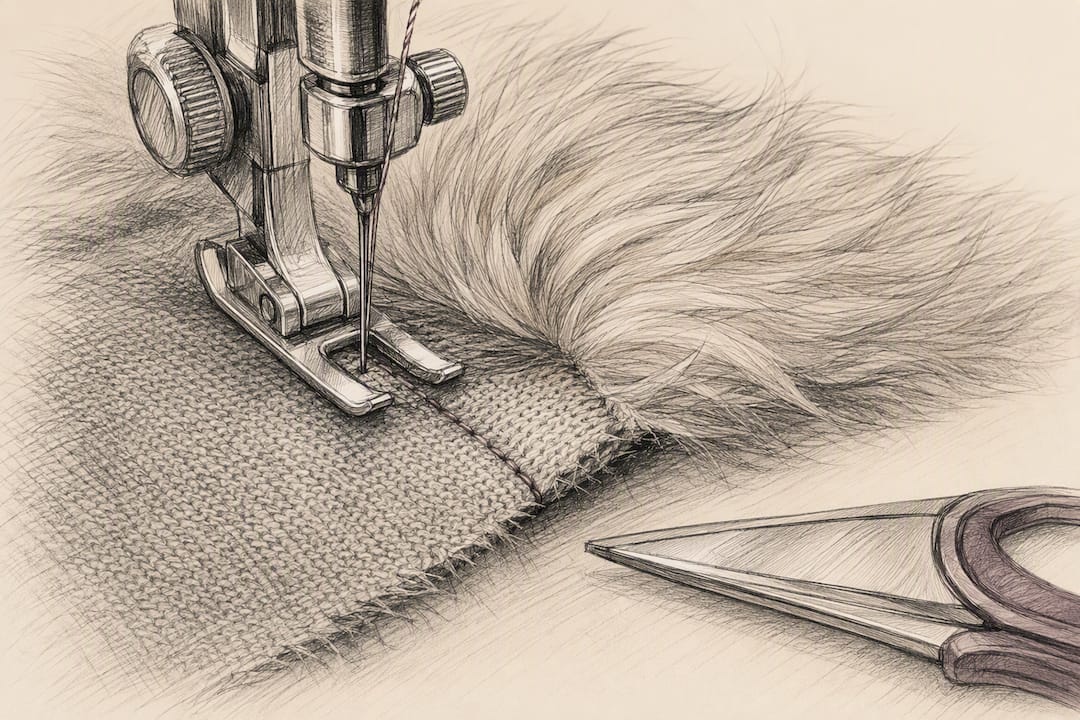
- Long pile (over 20mm): dramatic on a finished garment but genuinely harder to sew. Seams need trimming before stitching, or the pile gets trapped and bunches at every join. Sew Guide’s construction notes recommend trimming seam allowances down and stitching directly through the backing so long fibers don’t get caught inside the seam.
Shedding is the other practical issue nobody mentions until they’re mid-project. Longer pile sheds more during cutting and sewing, so plan on vacuuming your workspace and possibly serging raw edges before construction. If you’re making a lined coat, a short or medium pile exterior paired with a smooth lining fabric will always be easier to manage than a long-pile shell, regardless of skill level.
Common Fiber Materials: Polyester, Acrylic, and Modacrylic
Pile length tells you what a faux fur looks like from three feet away. Fiber content tells you what it feels like, how long it lasts, and what it costs. The three dominant fibers in faux fur production are polyester, acrylic, and modacrylic, and each one hits a different point on the price-to-realism spectrum.
- Polyester is the budget-to-mid-range default. It’s durable, holds color well through repeated washing, and tolerates machine care better than the alternatives, which makes it the go-to for craft projects and everyday accessories.
- Acrylic costs more but moves more like real fur, with a softer hand and better drape on a finished garment. It needs gentler cleaning, but the payoff is a coat or trim that photographs and hangs closer to the real thing.
- Modacrylic sits at the premium end. Beyond softness, it carries flame-resistant properties that make it common in costume work, children’s items, and anywhere fire safety standards matter.
Fast fact: many mid-range faux furs aren’t a single fiber at all. Blends running roughly 60 to 70% acrylic with 30 to 40% polyester are common because they split the difference, acrylic’s soft hand plus polyester’s durability, at a price below pure acrylic goods. Premium blends push past 80% acrylic or incorporate modacrylic outright.
For fashion pieces meant to drape and move, acrylic-rich blends generally outperform pure polyester. For craft projects, stuffed animals, or anything that’ll see heavy handling and frequent washing, polyester’s ease of care usually wins out.
Popular Faux Fur Textures and What They’re Best For
Walk into any fabric store or scroll a faux fur retailer’s catalog and you’ll hit a wall of style names that don’t mean much until someone translates them. Market naming conventions tend to cluster around these seven:
- Minky. Ultra short, dense, and velvety smooth, minky sits at the low end of the short-pile range. It’s the go-to for baby items, plush toys, and linings where a napped hand matters more than visual drama.
- Teddy. Slightly loftier than minky but still short to medium, teddy fur has a rounded, fuzzy texture that reads as cozy rather than glamorous. Great for casual jackets, hats, and soft trims.
- Faux mink or chinchilla. Dense, fine, and closely cropped, this texture mimics the tight, luxurious look of real mink. It photographs beautifully on fitted garments but shows sparse density fast if the base fabric is thin.
- Mongolian. Long, loosely curled strands with visible gaps between them, Mongolian fur is unmistakable and works best as an accent, collar, cuff, or statement coat, rather than a full garment where its open structure would look thin.
- Shaggy. Long, straight pile with a loose, tousled look. Popular for statement coats, costumes, and area throws where volume matters more than tailored precision.
- Bouclé, sometimes labeled chinchilla-style. A looped, textured pile with a curly, nubby surface. It’s forgiving to sew and reads as high-end when used for trim or accent panels.
- Faux shearling. A shorter, curled pile often paired with a suede-like backing to mimic sheepskin. Common in linings, boot cuffs, and cold-weather accessories.
The biggest pitfall across all seven: low-density versions of any texture look sparse and cheap on a fitted garment, even when the pile length is technically correct. If you’re buying online, check density claims before committing yardage to a full coat.
How to Choose Faux Fur for Your Project
Before you order yardage, run through a short checklist. Pile length, fiber content, and density matter most, but backing stability and lining needs determine how the finished piece actually performs.
- Pile length: short for tailoring, medium for everyday wear, long for statement pieces.
- Density: hold the fabric up to light. Sparse backing showing through means a thin, low-density weave that won’t hold up on a fitted silhouette.
- Fiber content: polyester for budget and easy care, acrylic for drape and realism, modacrylic where flame resistance matters.
- Backing and stability: a knit backing has more stretch and ease; a woven backing holds structure better for tailored coats.
- Lining needs: long pile especially benefits from a slippery lining so the coat slides on and off without pulling.
- Wear frequency: an everyday coat needs a more durable fiber blend than an occasional costume piece.
Project type changes the calculus, too. Tailoring calls for trimming pile close to every seamline before stitching, which keeps bulk down and seams flat. Upholstery projects should prioritize rub count and a stable, sometimes foam-backed, construction that can handle repeated sitting and friction. Costume and cosplay work leans on weight and drape, since a heavy long-pile fur can drag a costume’s silhouette out of shape over a full day of wear.
Pro Tip: Use a longer, sharper needle (size 90/14 or higher) and go slow. Faux fur’s backing is often a knit or woven fabric that can gum up a standard needle, and a slower feed keeps pile from getting pulled into the seam as you stitch.
Caring for Faux Fur: Washing, Drying, and Storage
Faux fur holds up well over time, but only if you handle cleaning and storage the way the fiber demands.
- Check the fiber before you wash. Polyester-heavy faux fur generally tolerates a gentle machine cycle in cold water; acrylic and modacrylic blends often do better hand-washed or dry-cleaned to protect the pile and backing.
- Skip high heat everywhere. Hot water and high dryer heat flatten pile permanently and can melt or glaze synthetic backing.
- Air-dry flat whenever possible. If a low-heat tumble cycle is safe for the fiber, use it briefly, then finish drying flat to avoid stretching the backing.
- Brush the pile once it’s dry. A wide-tooth pet brush or a fur-specific brush, run gently in the direction of the nap, restores loft after washing or a day of wear.
- Store hanging for coats, folded for smaller pieces. Crushing faux fur under other garments for months flattens the pile and can take a while to bounce back.
Pro Tip: For matting or minor snags, work the spot with your fingers and a wide-tooth comb before reaching for scissors, most matting releases with patience rather than trimming. For a deeper walkthrough of wash cycles and storage methods by fiber type, Primadonsanddonnas’s faux fur care guide and storage guide cover both in more detail.
How Prima Dons and Donnas Applies This Guide
Every faux fur piece made to order starts with the same questions this guide walks through: what pile length suits the silhouette, what fiber holds up to how often it’ll be worn, and what density keeps a fitted coat from looking thin at the seams. That’s the standard behind made-to-order custom outerwear, available in various sizes and colors, including extended plus sizes that ready-to-wear racks routinely skip.
- Custom faux fur outerwear built to individual measurements.
- Sustainable faux fur options.
- Special-occasion pieces, including birthday looks and photoshoot statement coats, adapted to the event.
- Ready-to-ship items available alongside custom build options.
Readers who want the sustainability angle in more depth can see how it factors into styling decisions in Primadonsanddonnas’s take on faux fur fashion.
Is Faux Fur Actually Better for the Environment?
Faux fur avoids the animal welfare concerns tied to real fur, but it isn’t automatically the greener choice. Most faux fur is petroleum-based, polyester, acrylic, and modacrylic are all synthetic, which means production draws on fossil fuels and the finished garment doesn’t biodegrade the way natural fiber does.
Recycled faux fur is an emerging category worth watching. Some manufacturers now spin polyester from recycled plastic (often bottles or ocean-bound waste) into fur-like pile, cutting down on virgin plastic use. But these recycled and sustainability claims depend heavily on certification and traceability, and not every “eco” label on a bolt of fabric means the same thing. A vague “sustainable” claim without a named certification is worth questioning before you buy.
The realistic way to think about faux fur’s environmental footprint: it’s a tradeoff, not a clean win. You’re avoiding the resource-intensive farming or trapping that real fur requires, but you’re adding a synthetic textile to the world that will likely outlast the garment itself in a landfill. Buying fewer, better-made pieces and caring for them properly, rather than replacing worn-out fast-fashion faux fur every season, does more for your actual footprint than any single fiber choice.
Which Faux Fur Types Last Longest?
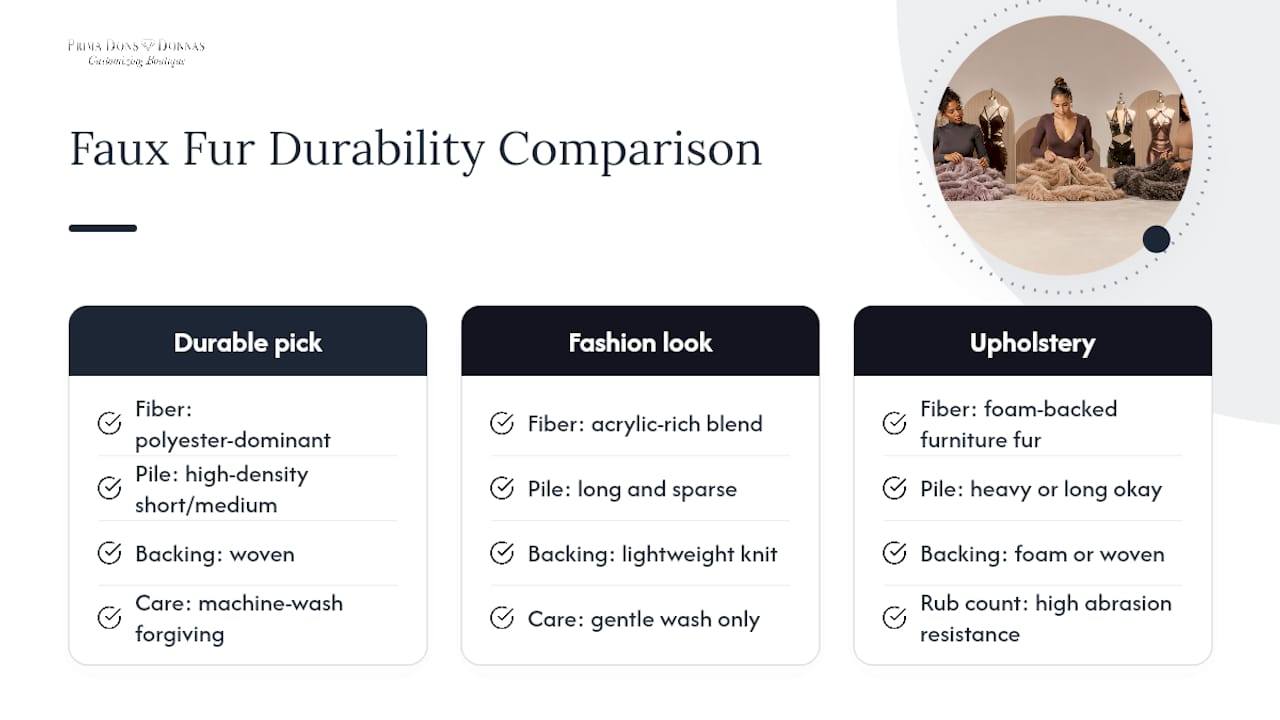
Durability comes down to density, fiber, and how the backing is constructed, more than pile length alone. A high-density short pile in a durable fiber will usually outlast a sparse, low-density long pile, even though the long pile looks more dramatic on day one.
Polyester-dominant fabrics tend to be the most forgiving over repeated wear and washing. The fiber resists pilling and holds its shape through machine washing better than acrylic, which is part of why polyester is the common choice for craft use and high-handling items. Acrylic-rich blends look and drape better on finished garments, but they generally need gentler care to avoid matting and fiber breakage over time, a real consideration for a coat you plan to wear all winter for several years.
Backing matters just as much as fiber. A woven backing generally resists stretching and sagging better than a lightweight knit backing, particularly on longer or heavier pile where gravity is constantly pulling at the base fabric. For upholstery specifically, rub count (a textile industry measure of abrasion resistance) becomes the deciding factor, and a foam-backed faux fur built for furniture will always outperform a garment-weight fabric asked to do a couch’s job.
Bottom line: if longevity is the priority, pick a dense, short-to-medium pile in a durable fiber over a dramatic long pile that looks better in photos than it wears in year three.
What Does Faux Fur Cost, and Why the Range Is So Wide
Faux fur pricing spans a wide range, and the fiber and construction behind the price tag explain most of the gap. Budget polyester fabrics sit at the low end, priced for craft projects, linings, and pieces where realism matters less than getting the job done affordably. Acrylic and acrylic-heavy blends cost noticeably more, reflecting the softer hand and better drape you’re paying for. Modacrylic and premium acrylic blends, especially anything marketed as flame-resistant or ultra-realistic, sit at the top of the range.
Density and pile length also move the price independent of fiber. A dense, longer pile uses more raw fiber per yard than a thin, short pile, so two fabrics in the same fiber category can carry different price points based purely on how much material went into each square yard.
For a made-to-order coat or statement piece, the yardage cost is only part of the total. Custom construction, cutting to individual measurements, hand-trimming seams to manage pile, adding a proper lining, adds labor that a mass-produced, single-size garment skips entirely. That’s the real reason a custom faux fur coat costs more than an off-the-rack version in the same fabric: the fabric price is similar, but the construction time isn’t.
What the Research Actually Supports
Most faux fur advice online treats pile length as an aesthetic choice. It isn’t. Pile length is a construction decision first, and looks second. The guides that skip the sewing implications, seam bulk, feeding through a machine, shedding during cutting, are giving you half the picture, and it’s the half that matters less once you’re actually holding fabric and a needle.
The conventional wisdom oversells “premium fiber” as the universal answer, too. Modacrylic and high-acrylic blends are genuinely better for realism and softness, but polyester still wins for craft projects, kids’ items, and anything that’ll see heavy washing. There’s no single best fiber, only a best fiber for what you’re building.
If you take one thing from this guide, prioritize density before pile length or fiber name. A dense, well-backed short pile beats a sparse, dramatic long pile on almost every practical measure, fit, seam quality, and how the finished piece ages. Buy for density first, and the rest of the decision gets a lot easier.
— Latoya
Find Your Faux Fur Piece at Prima Dons and Donnas
Now that you know the difference between a dense teddy pile and a sparse Mongolian trim, shopping for faux fur gets a lot less like guesswork and a lot more like knowing exactly what to ask for. Primadonsanddonnas builds that knowledge directly into every custom order: pile, fiber, and density chosen for your project, in your size, not the size a standard rack happens to stock.
If you’re after a coat with real drape and structure, the custom outerwear collection is built made-to-order in any size or color, faux fur included. Planning something for a wedding, a birthday shoot, or a night out and want a faux fur trim on the dress itself? The made-to-order dress collection covers special-occasion pieces built to your measurements, not the other way around. Pair a finished look with a clean accessory choice, like the lightweight everyday sunglasses from ROAV Eyewear, for a complete outfit from head to toe. Start by browsing the outerwear collection and requesting your size and color combination directly at checkout.
Sources
- Faux Fur Material Selection: A Complete B2B Configuration Guide - Alibaba.com Seller Blog
- What Is Faux Fur Fabric? Types, Uses & How It’s Made
- Types of Faux Fur Fabric Explained | 2026 Guide
- Different types of Faux Fur — Sew Guide
FAQ
What is the best quality faux fur?
The best quality faux fur combines high pile density with acrylic or modacrylic fiber content, since these fibers give a softer hand and more realistic movement than polyester alone. Check that the backing doesn’t show through the pile when held up to light, that’s the fastest way to spot a low-density fabric before you buy.
What are the different styles of faux fur coats?
Faux fur coats commonly come in shaggy long-pile styles for statement pieces, medium-pile teddy or plush styles for everyday wear, and shorter faux mink or chinchilla styles for a fitted, tailored look. Mongolian-style coats, with their long, loosely curled texture, are typically reserved for accent pieces or statement outerwear rather than full linings.
What is high quality faux fur made of?
High quality faux fur typically uses acrylic or modacrylic fiber, or a blend running roughly 60 to 70% acrylic with polyester, rather than pure polyester alone. Modacrylic in particular adds flame-resistant properties on top of a premium soft hand, which is why it shows up in higher-end and safety-sensitive pieces.
What faux fur types look most like real fur?
Faux mink and chinchilla-style textures look closest to real fur because of their dense, closely cropped pile and fine fiber structure. Acrylic-rich fabrics generally read as more realistic than polyester because the fiber catches light and moves more like natural fur, a distinction covered in more depth in Primadonsanddonnas’s comparison of faux fur versus real fur.


Leave a comment