

Industry Terminology in Custom Fashion 2026: Key Terms
TL;DR:
- Industry terminology in custom fashion 2026 blends traditional tailoring with technology and sustainability, creating a new language for professionals. Fluency in both foundational terms and emerging concepts like Digital Twin Fitting and Algorithmic Couturism is essential for industry leaders. Mastering this vocabulary improves communication, reduces errors, and reflects industry shifts toward faster, more sustainable production methods.
Industry terminology in custom fashion 2026 is the evolving vocabulary that blends traditional tailoring with technology and sustainability, and mastering it separates professionals who lead from those who fall behind. The custom apparel world has always had its own language, from “bespoke” to “Tech Pack,” but 2026 has introduced a new layer of terms shaped by generative AI, 3D body scanning, and circular design practices. Bodies like the Craft Council and industry standards groups continue to anchor foundational vocabulary, while emerging concepts like “Algorithmic Couturism” and “Digital Twin Fitting” push the lexicon forward. Whether you work in design, production, or client relations, fluency in this updated fashion lexicon is no longer optional. Primadonsanddonnas builds every made-to-order piece with this language in mind, from consultation to final stitch.
What are the key custom fashion terms every professional should know in 2026?
Custom fashion terms in 2026 fall into two camps: foundational vocabulary that has existed for decades and newer terms born from technology and sustainability demands. Knowing both is the baseline for any serious professional or enthusiast.
Foundational terms you must know
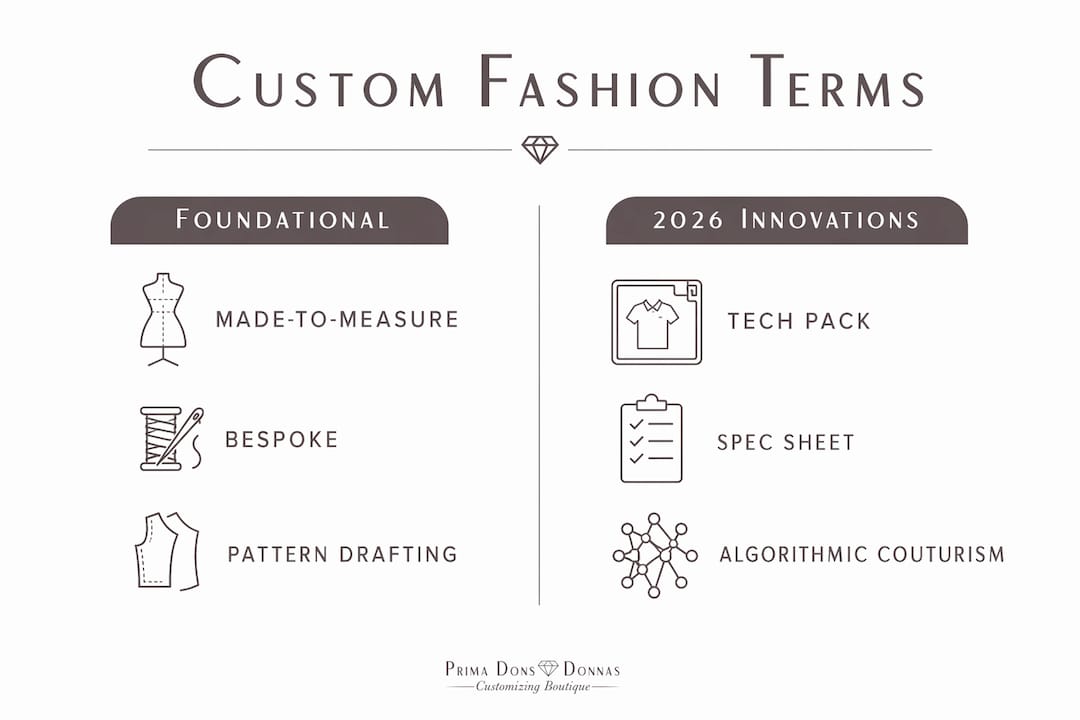
Made-to-Measure (MTM) adjusts an existing base pattern to fit a client’s measurements. It is faster and more affordable than fully bespoke work, making it the standard for most custom apparel brands operating at scale.

Bespoke means a pattern is created from scratch for one specific client. Bespoke involves 3–4 fittings over an 8–12 week period, which is why it commands a higher price and a longer commitment from both maker and client.
Tech Pack is the full construction document sent to a factory. It includes materials, stitching details, hardware specs, and construction diagrams. A Spec Sheet focuses only on measurements and tolerances. Mixing up Tech Packs and Spec Sheets causes factory errors that cost time and money.
Newer terms defining 2026 custom apparel language
- Digital Twin Fitting: A virtual garment projected onto a 3D-scanned body model, used to check fit before cutting fabric.
- Algorithmic Couturism: The use of generative AI to iterate bespoke patterns rapidly, cutting lead times significantly.
- Personalized Automation: A production model where technology handles repetitive tasks while artisans focus on craft details.
- Sustainable Sourcing Traceability: Tracking a material from raw fiber to finished garment to verify ethical and environmental standards.
- Circular Construction: Designing garments from the start to be recycled, repaired, or repurposed at end of life.
| Term | Focus | Key Difference |
|---|---|---|
| Tech Pack | Full construction details | Covers materials, hardware, stitching |
| Spec Sheet | Measurements only | Covers dimensions and tolerances |
| Made-to-Measure | Adjusted base pattern | Faster, lower cost |
| Bespoke | New pattern from scratch | Multiple fittings, higher cost |
| Digital Twin Fitting | Virtual fit check | Reduces physical prototypes |
Pro Tip: When briefing a factory, send both the Tech Pack and the Spec Sheet as separate documents. Combining them into one file is the single most common cause of miscommunication on the production floor.
How have technology and sustainability shaped new terminology in custom fashion by 2026?
Technology and sustainability are the two forces rewriting the custom fashion lexicon faster than any trend cycle. They are not separate conversations. They overlap constantly in how professionals write specs, brief factories, and talk to clients.
AI and 3D scanning
Algorithmic Couturism uses generative AI to iterate bespoke patterns rapidly, cutting lead times by 40%. That number matters because traditional bespoke timelines have always been a barrier for clients who want custom work but cannot wait months. Digital Twin Fitting addresses the same problem from the fitting side. Digital Twin Fitting reduces physical fittings by 30% in high-end custom fashion. Fewer fittings mean lower costs and faster delivery without sacrificing accuracy.
Sustainability vocabulary in technical specs
- Sustainable Sourcing Traceability now appears in client briefs and factory contracts as a standard requirement, not a bonus feature.
- Circular Construction shows up in pattern notes, specifying seam types and material choices that allow future recycling.
- Sustainability terms grew by 25% in technical specifications in 2026, reflecting how deeply eco-conscious design has entered production language.
- Fabric choices like bamboo and other eco-conscious materials now carry their own traceability language in sourcing documents.
“Terminology evolution mirrors broader industry shifts toward hybrid tech-artisanal processes balancing speed and craftsmanship.” — The Rise of AI-Designed Fashion
The term “Personalized Automation” captures this balance best. Clients expect faster turnaround with maintained craft quality. That expectation has forced the industry to name the process, and “Personalized Automation” is the phrase that stuck.
Pro Tip: When introducing tech-driven terms to clients, pair each new word with a plain-language explanation. “Digital Twin Fitting means we check your fit virtually before we cut a single piece of fabric” lands better than the term alone.
What are the practical distinctions between Made-to-Measure and Bespoke?
Clients often treat “custom” as one category. It is not. Custom is a spectrum from Made-to-Measure to fully Bespoke, and the difference affects cost, timeline, and the number of appointments a client must attend. Getting this wrong at the start of a project creates frustration on both sides.
Process comparison
The custom clothing lifecycle runs through five stages: consultation and measurements, pattern drafting, fabric selection, prototype creation (toile), and final garment assembly. The total lead time runs 6–12 weeks depending on the method chosen.
| Stage | Made-to-Measure | Bespoke |
|---|---|---|
| Pattern creation | Adjusted from base pattern | Built from scratch |
| Number of fittings | 1–2 | 3–4 |
| Lead time | 4–6 weeks | 8–12 weeks |
| Cost level | Moderate | Premium |
| Best for | Consistent sizing needs | Unique body proportions |
MTM works well for clients who fall close to standard sizing but need adjustments for length, width, or silhouette. Bespoke is the right call when a client’s proportions fall outside any standard base pattern, or when the garment demands a level of craft that only a fully custom process delivers.
Pro Tip: Educate clients on the MTM versus Bespoke distinction before they see pricing. A client who understands why Bespoke costs more will not push back on the number the same way a client who sees it cold will.
How to effectively use fashion industry jargon to improve production and client relations
Clear terminology is not about sounding technical. It is about preventing errors that cost money and damage trust. Mastering technical specification vocabulary like grade rules, seam allowances, and tolerance levels is the foundation of error-free production, whether a garment is AI-assisted or handmade.
- Standardize your documents. Use the same term for the same concept across every Tech Pack, Spec Sheet, and client brief. Switching between “ease allowance” and “comfort allowance” in the same project creates confusion at the factory level.
- Define terms in client-facing materials. A one-page glossary sent with a quote letter sets expectations before the first fitting. It also positions you as a professional who knows the process inside out.
- Separate construction from measurement documents. Tech Packs and Spec Sheets serve different purposes. Send them as separate files with clear labels so factory teams pull the right document for the right task.
- Update your vocabulary annually. The 2026 fashion terminology shift toward AI and sustainability means terms like “Circular Construction” and “Digital Twin Fitting” now appear in standard production conversations. Professionals who know these terms communicate faster and more credibly.
- Train your team together. Terminology only works when everyone on a project uses the same words. A brief team glossary review at the start of each new collection prevents the kind of miscommunication that shows up as a production mistake three weeks later.
Pro Tip: Run a quick terminology audit on your last three Tech Packs. If you find more than two different phrases for the same spec detail, you have a communication risk that needs fixing before the next production run.
Key takeaways
Mastering industry terminology in custom fashion 2026 requires fluency in both foundational terms like Bespoke and MTM and emerging vocabulary like Algorithmic Couturism and Digital Twin Fitting.
| Point | Details |
|---|---|
| Tech Pack vs. Spec Sheet | Keep these as separate documents to prevent costly factory miscommunication. |
| MTM vs. Bespoke | MTM adjusts existing patterns; Bespoke builds from scratch with 3–4 fittings over 8–12 weeks. |
| AI-driven terms | Algorithmic Couturism cuts lead times by 40%; Digital Twin Fitting reduces physical fittings by 30%. |
| Sustainability vocabulary | Terms like Circular Construction and Sustainable Sourcing Traceability are now standard in technical specs. |
| Client education | Explaining the custom spectrum early prevents cost and timeline misunderstandings. |
The language of custom fashion is changing faster than most people realize
I have spent years watching the custom fashion world evolve, and the terminology shift happening right now is unlike anything before it. It is not just new words. It is a signal that the entire production model is changing.
What strikes me most is how quickly terms like “Algorithmic Couturism” moved from conference presentations to actual factory briefs. Two years ago, a designer who used that phrase in a client meeting would have gotten blank stares. Now it shows up in sourcing conversations and production timelines as if it has always been there.
The professionals who struggle are not the ones who lack technical skill. They are the ones who treat new terminology as optional. They keep using “custom” as a catch-all when a client needs to understand the difference between made-to-order and bespoke before they commit to a timeline and a budget.
My honest advice: do not chase every new term. Learn the ones that directly affect your production process and your client conversations. “Digital Twin Fitting” matters if you are working with 3D scanning. “Circular Construction” matters if you are sourcing sustainable fabrics. Start there, and build outward.
The foundational vocabulary, grade rules, seam allowances, toile, Tech Pack, never goes out of style. New terms sit on top of that foundation. The professionals who stay competitive are the ones who hold both layers at once.
— Latoya
Custom made-to-order pieces built for every size and occasion
Primadonsanddonnas puts the terminology into practice with every piece it produces. Every garment starts with a client’s measurements and ends with a bold, confident look built for the moment.
The made-to-order dress collection covers party events, concerts, lunch dates, and wedding apparel, all available in plus sizes and any color. Custom boots, including thigh-high styles in plus sizes, are available through the boots collection. Ready-to-ship options are also available for clients who need a statement piece fast. Shop the full range at Primadonsanddonnas and find the fit that was made for you.
FAQ
What does “Made-to-Measure” mean in custom fashion?
Made-to-Measure adjusts an existing base pattern to fit a client’s specific measurements. It is faster and less expensive than Bespoke, with a typical lead time of 4–6 weeks and 1–2 fittings.
What is the difference between a Tech Pack and a Spec Sheet?
A Tech Pack covers full construction details including materials, stitching, and hardware. A Spec Sheet focuses only on measurements and tolerances. Confusing the two leads to factory errors that delay production.
What is “Algorithmic Couturism” in 2026 fashion terminology?
Algorithmic Couturism uses generative AI to rapidly iterate bespoke patterns, cutting lead times by 40%. It integrates 3D body scans to produce a precise custom fit faster than traditional methods.
Why does sustainability terminology matter in custom apparel?
Terms like Sustainable Sourcing Traceability and Circular Construction now appear as standard requirements in technical specifications. These terms grew by 25% in production documents in 2026, reflecting how eco-conscious design has become a production standard, not a marketing add-on.
How does “Digital Twin Fitting” change the custom garment process?
Digital Twin Fitting projects a virtual garment onto a 3D-scanned body model to check fit before any fabric is cut. It reduces physical fittings by 30%, saving time and material costs in high-end custom fashion production.
Recommended
- Luxury Fashion Terminology Explained: Empower Your Style – Prima Dons & Donnas
- Trends in Custom Fashion 2026: Bold Style and Personalization – Prima Dons & Donnas
- Guide to expressing style with custom fashion in 2026 – Prima Dons & Donnas
- Custom Fashion and Self-Expression: Why It Matters – Prima Dons & Donnas


Leave a comment