

Pack Boots for Travel Without Creases: Material-Safe Tips and Picks
Wear your heaviest boots through the airport if suitcase space is tight; otherwise pack them stuffed and individually bagged. Clean them first, stuff each shaft with socks or small items, slide each boot into its own bag, and place them toe-to-heel at the bottom of your case. Expect TSA to inspect boots at the checkpoint, and know that checked bags carry more risk of leaks or crushing than carry-ons.
TL;DR:
- Packing fewer, versatile pairs of boots helps save space and reduces risk of damage during travel; choose shoes that match multiple outfits and activities.
- Stuff boots with socks or small items to maintain shape, and pack each boot in its own bag to prevent sole dirt from staining other items.
- Use soft barriers like shoe bags or plastic bags around each boot to protect delicate materials and avoid scuffing or staining clothes inside the suitcase.
- Carry boots in your carry-on if possible, for easier access and security checks, but be prepared for possible extra scrutiny at TSA.
- For tall or embellished boots, fully stuff the shafts with clothing or stuffing materials to prevent creasing and maintain their form during transit.
Table of Contents
- How Do You Prepare Boots Before Packing Them for a Trip?
- What’s the Best Way to Stuff and Position Boots in a Suitcase?
- How Do You Keep Boots From Scuffing or Staining Other Items?
- Should Boots Go in a Carry-On or Checked Bag?
- What If Your Boots Won’t Fit Without Sacrificing Space?
- Do Hiking Boots and Fashion Boots Need Different Packing Approaches?
- Are Boot Shapers or Inserts Worth Packing?
- How Does Weather Affect the Way You Pack Boots?
- Which Boots Should You Actually Pack for Your Trip?
- What Custom and Statement Boots Teach You About Careful Packing
- Travel-Ready Boots Built for the Trip You’re Actually Taking
- Sources
- FAQ
How Do You Prepare Boots Before Packing Them for a Trip?
Boots that go into your suitcase dirty or damp will come out worse, and they can stain everything packed near them. Wipe down leather with a damp cloth, brush off caked dirt from soles, and spot-clean any faux fur or rhinestone trim before they touch your clothes.
Check the insoles too. If they smell even faintly, air them out overnight and drop in a small deodorizer packet for longer trips. Nobody wants that smell rising out of a suitcase on day four of a trip.
This is also the moment to decide what actually goes in the bag. A travel packing expert who packs boots professionally recommends choosing fewer, more versatile pairs rather than trying to solve a crowded suitcase with clever tricks. One ankle boot or Chelsea boot that works for dinner, a walking tour, and a rainy afternoon beats three specialized pairs fighting for the same suitcase space.
Before you pack, run through this:
- Wipe leather clean and brush dirt off soles.
- Spot-treat faux fur, suede, or rhinestone details with the right cleaner for that material.
- Pull insoles if they hold odor, and air them separately.
- Choose one or two pairs that cover the most outfits, not every pair you own.
- Decide now whether you’ll wear a pair through security to save space later.
What’s the Best Way to Stuff and Position Boots in a Suitcase?
Dense, small items do double duty inside a boot: they hold its shape and use space that would otherwise sit empty. Rolled socks, underwear, phone chargers, even a folded scarf all work well stuffed into the toe and shaft. Bag loose or soft items first if there’s any chance they could shift or leak.
Once each boot is stuffed, orientation matters as much as the stuffing itself. Packing expert advice points to placing boots toe-to-heel or with shafts pointing opposite directions, which forms a compact, stable block instead of two lopsided lumps.
Here’s the sequence that works every time:
- Stuff each boot fully, from toe to the top of the shaft.
- Bag each boot separately (more on that below).
- Lay them toe-to-heel, or with one shaft facing left and the other right.
- Push rolled clothing or a packing cube into any remaining gaps around them.
- Use the boots as your suitcase’s structural base, not an afterthought squeezed in last.
Pro Tip: Stuff a small jewelry pouch or your phone charger cable coil into the toe of the boot. You save a packing step and protect fragile items in one move.
How Do You Keep Boots From Scuffing or Staining Other Items?
Boots track dirt, and their soles can scuff up a silk dress or a light-colored blouse packed too close. The fix is simple: give every boot its own barrier before it goes near anything else.
A shoe bag, shower cap, or even a plastic grocery bag works as a one-boot barrier that stops sole dirt from spreading. Southern Living’s packing guidance recommends exactly this approach, particularly for boots that have been worn outdoors right before the trip.
Packing cubes add a second layer of protection on top of that. They keep boots contained if a bag tears, and they add structural protection against leaks and scuffs that a loose plastic bag alone can’t match.
For anything delicate, take it a step further:
- One bag per boot, always. Never let bare soles touch clothing directly.
- Add a packing cube around bagged boots if your suitcase has room.
- Slip tissue paper or a soft cloth between faux fur and any bag lining to prevent flattening.
- Wrap embellished or rhinestone boots in a soft cloth boot wrap before bagging.
Should Boots Go in a Carry-On or Checked Bag?
Carry-ons keep boots under your control, but be ready to pull them out at security if an officer asks. Checked bags skip that step entirely, at the cost of more handling, more compression risk, and more exposure if something in the bag leaks.
The Transportation Security Administration notes that screening officers have discretion over what gets extra scrutiny, and that includes boots with thick soles, support features, or metal hardware. Pack carry-on boots so you can access and remove them fast, rather than burying them under everything else in your bag.
Quick comparison:
- Carry-on: faster access, but possible removal at the checkpoint; pack near the top.
- Checked: no security handling, but higher risk of crushing or leak damage; pack at the bottom with strong barriers.
- Either way: TSA can ask you to empty or remove boots for inspection, so don’t wedge them somewhere you can’t reach.
One travel insight worth planning around: the real tradeoff isn’t security hassle versus damage risk in the abstract, it’s how much handling friction you’re willing to accept in exchange for lower crushing risk. There’s no universally right answer, only the one that fits your trip.
What If Your Boots Won’t Fit Without Sacrificing Space?
Wearing your boots through check-in, security, and boarding is a legitimate space-saving move, not a workaround. Change into lighter shoes once you’re seated, and you’ve freed up a chunk of suitcase real estate without packing an extra pair of shoes to hold that pair.
For longer stays, shipping boots ahead or buying a pair at your destination can solve the problem entirely, though both come with tradeoffs.
- Wear-and-swap: Wear boots through the airport, then change into lightweight travel footwear for the flight itself.
- Ship ahead: Works for long stays with a fixed address, but adds cost and requires timing the delivery correctly.
- Buy locally: Skips the packing problem altogether, though it means paying twice for footwear and hoping local sizing works.
- Multiple pairs: If you truly need more than one pair, put the bulkier boots at the bottom of the suitcase for stability during handling and consider sacrificing a lighter pair in favor of packing cubes for the rest of your outfits.
Do Hiking Boots and Fashion Boots Need Different Packing Approaches?
Hiking boots and fashion boots fail in different ways, so they need different handling. A hiking boot’s problem is bulk and weight. A fashion boot’s problem is a delicate finish that scuffs, creases, or stains easily.
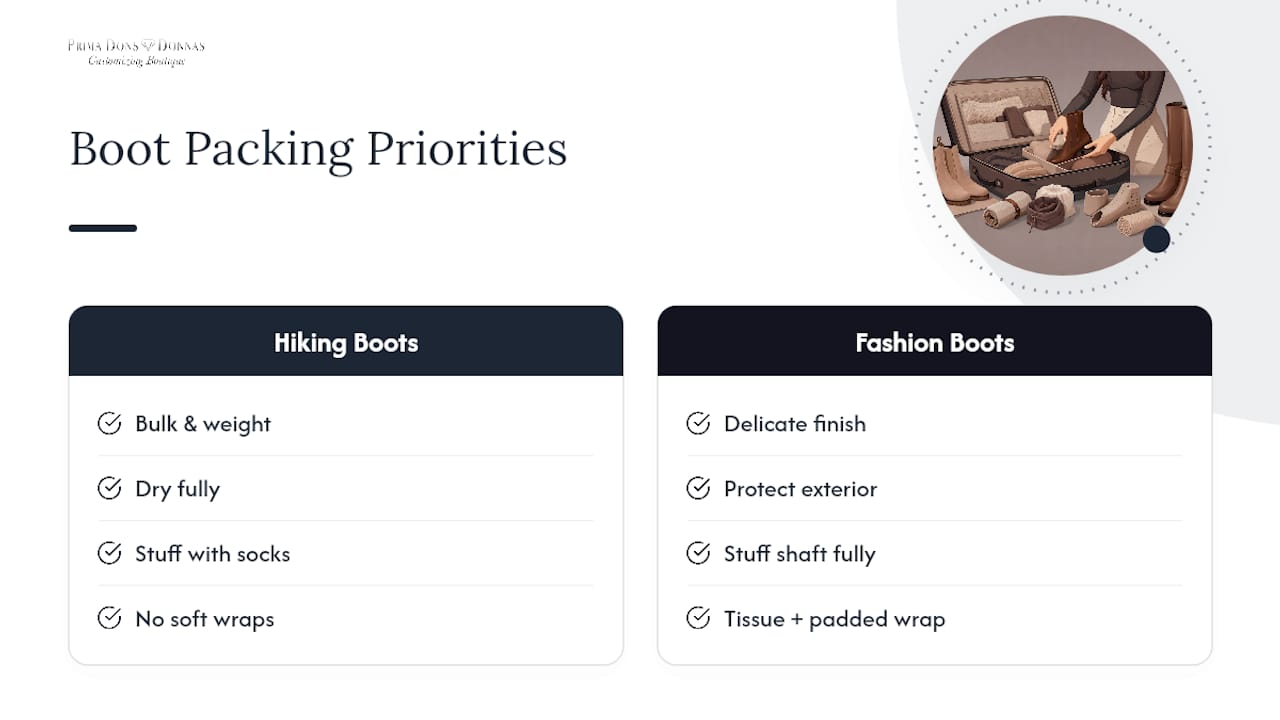
For hiking boots, focus on drying them out completely before packing. Damp hiking boots packed straight from a trail can grow odor fast, and their thick soles take up more room than most travelers expect. Stuff them with socks to hold shape, but don’t bother with soft wraps. These boots are built to take a beating, so a sturdy shoe bag or even a mesh laundry bag is enough of a barrier.
Fashion boots, especially anything with suede, embellishment, or a fitted shaft, need the opposite priority: protecting the exterior matters more than managing bulk. A knee-high boot with rhinestone detailing or faux fur trim should get tissue paper between layers and a padded or soft cloth wrap before it goes into a bag. If you’re working with a tall or custom-fit boot, the shaft is the most vulnerable part. Stuff it fully so it holds its curve instead of buckling under the weight of other items packed on top.
Ankle boots and Chelsea boots split the difference nicely, which is part of why they’re often the smartest single pair to bring on a shorter trip. They pack flat, resist scuffing better than a tall boot, and work across more outfits than either a rugged hiking boot or a formal knee-high.
Are Boot Shapers or Inserts Worth Packing?
Boot shapers help most with tall boots that tend to flop over and crease during transit, but they’re optional for low-profile styles like ankle boots. A shaper’s job is simple: keep the shaft rigid so it doesn’t fold, sag, or develop a permanent crease line partway up the leg.
If you own dedicated boot shapers, they’re worth the extra space for knee-high or thigh-high boots specifically. For everyday travel, though, a rolled magazine, a foam pool noodle segment cut to size, or simply tight, even stuffing with clothing does nearly the same job. The goal isn’t the product, it’s the result: a shaft that holds its shape without a fold line.
Inserts matter more for cushioning and moisture than shape. If a boot has a removable insole, check it for wear or odor before your trip. A insert that’s breaking down inside the boot won’t get better from being packed inside a hot cargo hold for a few hours.
One packable trick worth knowing: cardboard tubes cut to shaft height, wrapped in a soft cloth, work almost as well as commercial boot shapers and take up far less luggage space than a rigid store-bought shaper. If you’re bringing a pair with sentimental or higher cost value, that small bit of structure is worth the two minutes it takes to set up.
Skip shapers entirely for hiking boots or short ankle boots. Their sturdier construction and low shaft height mean the risk of permanent creasing is low, and the space a shaper takes up isn’t worth it for that pair.
How Does Weather Affect the Way You Pack Boots?
Weather changes what you’re protecting against more than it changes the packing method itself. A trip to a wet climate means your bigger risk is moisture getting trapped inside the boot during transit, not just scuffing on the outside.
If you’re heading somewhere rainy or snowy, dry boots completely before packing them, even if that means wearing slightly damp boots on travel day rather than sealing moisture into a bag. Trapped moisture inside a sealed shoe bag for a multi-hour flight can set the stage for odor or even mildew by the time you unpack.
For faux fur boots or trim, cold and damp climates raise the stakes on protecting the material itself. Faux fur that gets compressed while wet can mat down and lose its texture, so pack these boots with extra room in their stuffing rather than jamming them tightly against other items. A quick brush-out after arrival usually restores the look, but starting dry gives you a better result.

Hot, dry destinations flip the concern toward the suitcase environment rather than the boots. Cargo holds and car trunks can get warm enough to soften certain adhesives or trims, so keep embellished or glued detailing away from direct contact with anything else that might press into it during transit.
The simplest rule across all conditions: match your barrier strength to the climate. Wet destinations call for a sealed plastic bag as the outer layer. Dry destinations are more forgiving, and a breathable shoe bag is usually enough.
Which Boots Should You Actually Pack for Your Trip?
The best boots for traveling are the ones that match what you’re actually doing, not the ones that look best in a photo. A city trip built around walking, dinners, and maybe one dressy event calls for different footwear than a hiking trip or a beach wedding with an evening reception.
Start with your itinerary, not your closet. If most days involve walking on pavement, lightweight travel footwear with a flexible sole beats a heavier boot every time, even if the heavier pair looks better with your outfit. Save the statement boot for the one or two occasions that call for it.
For trips centered on outdoor activity, hiking boots earn their bulk. They’re not a fashion decision, they’re a function decision, and packing tips for hiking boots come down to drying them out and giving them a sturdy bag rather than worrying about creasing or trim damage.
For trips centered on events, whether that’s a concert, a lunch date, or a wedding, a versatile fashion boot usually outperforms bringing multiple specialized pairs. A single well-chosen pair of ankle boots or a knee-high boot in a neutral color works across a surprising range of outfits, which cuts down on how much you need to pack in the first place.
The travelers who struggle most with boot packing are usually the ones who packed for every possible outfit instead of the actual schedule. Look at your days first, then pick boots.
What Custom and Statement Boots Teach You About Careful Packing
Fashion and footwear work daily with materials that don’t forgive careless packing: faux fur, rhinestone trim, tall custom shafts. That perspective shapes a simple rule. Treat every boot like the most delicate pair you own, even when it isn’t.
Faux fur needs airflow and a soft barrier, never a tight plastic seal that flattens the pile. Thigh-highs and other tall boots benefit from upright storage whenever your suitcase allows it, since standing them up reduces the chance of the shaft folding under weight. A quick brush-out or steam on arrival fixes most travel wrinkles in embellished materials, so don’t panic if a boot looks a little worse for wear the moment you unpack it.
Custom-fit boots hold up better through travel handling than off-the-shelf pairs, largely because a shaft built to your actual leg shape has less empty space to collapse in transit.
— Latoya
Travel-Ready Boots Built for the Trip You’re Actually Taking
Packing smarter starts with owning boots that fit well and hold their shape through a flight, which means less stuffing, less shaping, and fewer creases to worry about when you land.
Look at ankle boots and Chelsea boots first if you want the most versatile option for a short trip. If you’re set on a thigh-high or a faux fur pair, choose a durable, neutral-colored sole and shaft so the boot pairs with more of what’s already in your suitcase. Custom sizing also solves a packing problem before it starts: a boot that fits close to your leg has less empty shaft space to collapse or crease during transit.
Ready-to-ship styles ship fast for travelers on a tight timeline, while made-to-order pieces take longer but deliver an exact fit worth the wait for a longer trip or a special event. Browse the full boots collection to find your next travel-ready pair, plus-size and custom options included, and get it ordered in time for your next departure date.
Sources
The packing methods above draw on boot-specific advice from Travel + Leisure and Southern Living, plus official screening guidance from the Transportation Security Administration. Each source is linked above at the point its specific claim is made.
- I’m a Packing Expert —Here Are 3 Major Mistakes I Avoid When Packing Boots
- How to pack boots in a suitcase
- Support Braces (Knee, Ankle, Wrist, Back) | Transportation Security Administration
FAQ
What Are the Best Boots for Traveling?
Versatile, low-bulk styles like ankle boots or Chelsea boots travel best because they pack flat, resist scuffing, and pair with more outfits than a specialized or heavily embellished pair.
What Are the Best Shoes to Wear on a Flight?
Lightweight, easy-to-remove shoes work best for the flight itself; many travelers wear their heaviest boots through security, then swap into lighter shoes once seated to save luggage space.
Can You Get Through TSA With a Walking Boot or Boots With Support Features?
Yes, but the TSA notes that officers have discretion, and support braces or thick-soled boots may need extra screening, so be ready to remove or empty your boots if asked.
Can You Pack Boots in a Carry-On?
Yes, boots are allowed in carry-on bags, but pack them near the top where they’re easy to remove for inspection, since carry-on items face more direct handling at the checkpoint than checked bags.
How Do You Stop Tall Boots From Creasing in a Suitcase?
Never fold a tall boot to fit it in; instead, stuff the shaft fully with socks or small items and pack it upright or on its side without bending the leather.


Leave a comment