

Rhinestone Dress Care: Preserve Crystals With 1–2 Tbsp Detergent
Hand-wash your rhinestone dress in cold water with a mild, pH-neutral detergent, turning it inside out first. Skip the soak, skip the dryer, and skip fabric softener entirely. Air dry flat or on a padded hanger. Spot-clean whenever you can instead of running a full wash, since less water and fewer chemicals mean less stress on the adhesive holding every stone in place.
TL;DR:
- Using cold water, a mild pH-neutral detergent, and gentle handling minimizes stone loss and preserves adhesive strength during hand-washing.
- Always turn the dress inside out before washing to prevent direct pressure on rhinestones and inspect stones for looseness beforehand.
- Air drying flat or on a padded hanger away from heat and sunlight is essential to maintain the dress’s integrity, avoiding tumble dryers entirely.
- Spot-cleaning is preferable to full washes, targeting stains with mild solutions and testing first to prevent adhesive damage, especially from harsh chemicals.
- Proper construction, including strategic stone placement and careful storage, significantly extends the lifespan of rhinestone dresses.
Table of Contents
- How Do You Properly Wash a Rhinestone Dress?
- Why Does Heat Ruin Rhinestone Adhesive So Fast?
- What’s the Safest Way to Spot-Clean a Rhinestone Dress?
- How Should You Dry an Embellished Dress Without Damage?
- How Should You Store a Rhinestone Dress Between Wears?
- What Are the Most Common Rhinestone Care Mistakes?
- What Do Prima Dons and Donnas’ Designers Recommend?
- A Conservative Approach Pays Off
- Built for Fewer Wash-Day Worries
- Sources
- FAQ
How Do You Properly Wash a Rhinestone Dress?
Most damage to embellished gowns happens before the dress ever touches water, when someone reaches for the wrong detergent or decides a quick machine cycle will save time. It won’t. Here’s the sequence that actually protects both the fabric and the stones.
Hand-washing, step by step
- Fill a basin or clean sink with cold water. Hot water softens the adhesive under hotfix and glued rhinestones almost immediately.
- Add 1 to 2 tablespoons (15 to 30 mL) of a mild, pH-neutral detergent per basin. No more. Extra suds don’t clean better, they just take longer to rinse out.
- Turn the dress inside out before it goes in the water. This single step keeps direct pressure off the stone settings.
- Submerge and gently swish for about three to five minutes. Never scrub, twist, or wring the fabric near an embellished panel.
- Rinse under cool running water until it runs completely clear, pressing the fabric gently rather than squeezing.
That’s the whole method. It looks almost too simple for a dress covered in hundreds of tiny crystals, but experts consistently point to minimal washing and gentle handling as the difference between a gown that lasts for years and one that sheds stones after a single wash.
When the machine is unavoidable
Sometimes hand-washing isn’t realistic, maybe the dress is heavily beaded, or you’re working with limited time before an event. If you must use a machine, follow this checklist:
- Use the delicate or gentle cycle only, never a standard or heavy-duty setting.
- Wash in cold water alone, with no other garments in the load.
- Zip the dress into a mesh delicates bag to reduce friction against the drum.
- Set the spin cycle to the lowest available speed, or skip spinning entirely if your machine allows it.
- Remove the dress the moment the cycle ends. Letting it sit damp against other fabric invites color transfer and prolongs moisture exposure near the adhesive.
Pro Tip: Before washing anything, run your fingers lightly across every stone. If any feel loose or wiggle slightly, secure or remove them first. Washing a dress with a half-attached rhinestone almost guarantees you’ll lose it, along with a few of its neighbors.
Why Does Heat Ruin Rhinestone Adhesive So Fast?
The glue behind most rhinestone settings, whether hotfix or hand-applied, is designed to bond at room temperature and stay flexible. Heat undoes that chemistry. Hot water, dryer cycles, and direct iron contact all soften the adhesive layer, and once it softens, even light movement can pop a stone loose. Agitation makes it worse. A washing machine’s spin cycle throws fabric against the drum and against itself, and every collision is a small chance for a crystal to catch, bend its setting, or shear off completely.
Heat is the primary threat to rhinestone adhesive, more so than water itself. A cold wash with rough handling will still cause less damage than a warm wash handled gently, but the safest approach avoids both risks at once.
The safe machine settings, in short:
- Cold water only, never warm or hot
- Delicate or gentle cycle, lowest spin speed
- Protective garment bag, washed alone
- No fabric softener and no bleach-based products
- A full inspection for loose or missing stones once the dress is dry
Retailer care guidance frequently forbids fabric softener outright for embellished garments, since the chemical coating designed to soften fibers also breaks down the adhesive bond underneath each stone. If you’ve ever pulled a “delicate” dress from the wash and found a trail of crystals stuck to the inside of the bag, this is almost always why.
What’s the Safest Way to Spot-Clean a Rhinestone Dress?
A full wash should be your last resort, not your first move. Spot-cleaning limits how much water and detergent ever touches the adhesive, which is exactly why designers and retailers recommend it for anything short of a major spill.
- Identify the stain type before choosing a cleaner. Makeup, deodorant, and grease each respond differently.
- Test any cleaning solution on a hidden seam or inner hem first. Wait a few minutes and check for discoloration or loosened stones before treating the visible area.
- For makeup or light grime, dampen a soft cloth or cotton swab with a mild soap and water mixture and dab gently, working from the outside of the stain inward.
- For grease marks, apply a tiny amount of isopropyl alcohol to a cotton swab and blot immediately. Don’t pour it directly onto the fabric, and don’t let it sit.
- Rinse the treated spot with a clean, barely damp cloth to lift residue, then blot dry with a towel.
Skip pre-wash stain sprays, chlorine or oxygen bleach, and anything labeled as a fabric conditioner. These products are formulated for cotton and synthetic blends, not for adhesive-backed embellishments, and they tend to leave the exact residue you’re trying to remove. If a stain doesn’t budge with gentle spot treatment, that’s your signal to stop and consider a professional cleaner rather than escalating to stronger chemicals at home.
How Should You Dry an Embellished Dress Without Damage?
Air drying is non-negotiable for anything covered in rhinestones. Turn the dress inside out, then lay it flat on a clean towel or drape it over a padded hanger, away from direct sunlight and away from radiators or heating vents. Sunlight and direct heat sources both accelerate adhesive breakdown even without a dryer involved.
- Never use a tumble dryer on medium or high heat. If a dryer is truly your only option, use the air-only or lowest-heat setting for the shortest possible time, and check the dress the moment it’s done.
- Reshape the garment while it’s still damp, smoothing seams and pleats by hand so it dries closer to its finished shape.
- Skip ironing over rhinestones entirely. Turn the dress inside out and press from that side using a thin press cloth, or hold a handheld steamer several inches away from the embellished panels instead of touching them directly.
Pro Tip: If you’re pressed for time before an event, hang the dress in a steamy bathroom for ten minutes instead of ironing. The ambient humidity relaxes wrinkles without any heat source anywhere near the stones.
How Should You Store a Rhinestone Dress Between Wears?
Storage mistakes cause almost as much damage as bad washing habits, just slower. A dress crammed onto a wire hanger between two coats will lose stones to friction over months, even if it’s never seen a washing machine.
- Store heavily beaded or fully embellished gowns flat rather than hanging, since the weight of dense stonework can stretch fabric and stress adhesive over time.
- Use padded hangers for lighter rhinestone pieces, such as cocktail dresses or party tops with scattered embellishment.
- Separate embellished panels from other garments with soft cloth or acid-free tissue to prevent stones from catching on zippers, sequins, or buttons nearby.
- Keep the dress in a breathable garment bag, stored somewhere cool, dry, and out of direct light. Basements and attics with fluctuating temperatures are worse choices than a closet interior.
- For travel, lay the dress flat in a garment bag when possible, and tuck tissue paper between heavily embellished sections so the panels don’t rub against each other in transit.
If you’re planning ahead for a wedding, a concert, or a milestone birthday shoot, this is also where a rhinestone dress designed for the occasion earns its price. A well-constructed piece tolerates careful storage far better than something with stones glued on as an afterthought.
What Are the Most Common Rhinestone Care Mistakes?
Even careful owners tend to repeat the same handful of errors, usually without realizing which habit is causing the damage.
- Using fabric softener. It coats and weakens the adhesive bond, which is why manufacturer care instructions explicitly warn against it.
- Washing more often than necessary. Every wash cycle is a small risk. A dress worn once for a few hours rarely needs a full wash at all, just a spot check.
- Spraying deodorant or perfume directly onto embellished areas. Aluminum compounds in many deodorants can weaken adhesive and stain fabric, so apply products before dressing and let them dry fully first.
- Reaching for solvent-based jewelry polish to restore shine. These often leave a film that dulls stones further. A soft-bristled brush or a barely damp microfiber cloth works better and restores shine without touching the adhesive layer.
If a stone does come loose, the repair depends on how it was originally set. Hotfix stones have a heat-activated adhesive backing and can sometimes be reapplied with a hotfix applicator tool on a low setting. Glued stones respond well to jewelry-grade adhesives like Gem-Tac or E6000, applied in a tiny dot to the back of the stone before pressing it back into place. Sew-on stones need a needle and thread through the existing holes, not glue at all.
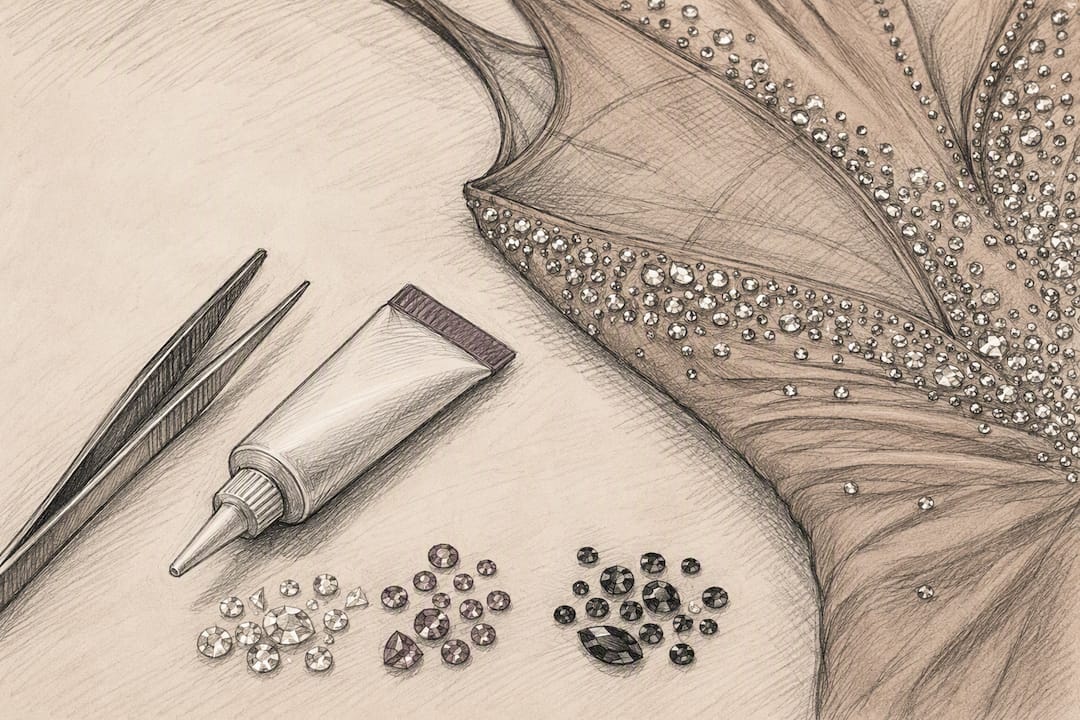
Pro Tip: Keep a small repair kit, a tube of E6000, a pair of tweezers, and a few loose stones in the dress’s original color family, so a wardrobe emergency thirty minutes before an event doesn’t turn into a real crisis.
What Do Prima Dons and Donnas’ Designers Recommend?
Construction choices made before a dress ever reaches you matter as much as how you wash it afterward. Rhinestones set with quality adhesive, spaced to avoid friction points, and backed by well-finished seams simply hold up better over repeated wear.
- Look for garments where stone placement avoids high-friction zones like underarms and inner thighs.
- Check product pages for care notes specific to that piece’s embellishment style before you buy.
- Read our designer’s guide to couture rhinestone construction for a closer look at what separates a dress built to last from one built to photograph well once.
Designer Latoya’s working rule for her own embellished pieces: preserve first, test second, ask third. Spot-clean before you commit to a full wash, test any product on a hidden seam, and reach out to the brand directly if a specific fabric or stone type leaves you unsure.
A Conservative Approach Pays Off
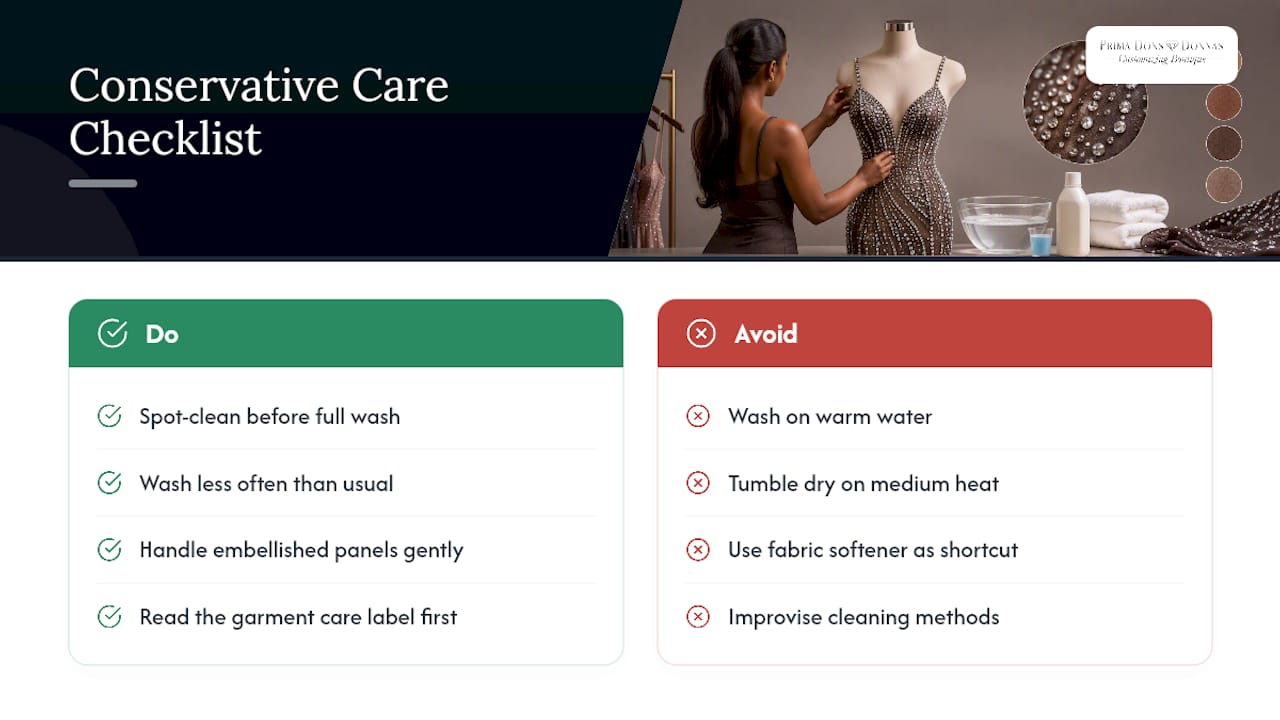
Most damage to rhinestone dresses isn’t the result of one dramatic mistake. It’s the slow accumulation of small shortcuts: one wash on warm, one trip through the dryer on medium heat, one round of fabric softener because the bottle was already on the shelf. Spot-clean before you commit to a full wash. Wash less often than you think you need to. Handle every embellished panel like it’s more fragile than the rest of the garment, because it is.
Read the care label before you improvise a cleaning method, and don’t hesitate to reach out to Primadonsanddonnas directly if a specific fabric, stone type, or construction detail leaves you uncertain. Conservative care always beats an aggressive fix after the fact.
— Latoya
Built for Fewer Wash-Day Worries
Primadonsanddonnas designs rhinestone dresses with the wash routine in mind from the start, choosing stone placement and settings that hold up to the gentle care outlined above instead of demanding constant repair.

Browse the ready-to-ship collection if you need something in hand quickly for a concert, a lunch date, or a last-minute party invite, including pieces like the Maxi Rhinestone Dress in crystal string silver. Prefer something built around your exact measurements and color palette? The made-to-order dress collection lets you request construction choices, including plus size fits, that reduce the care burden down the road. Running short on time before an event, Express Shipping and the Rush Processing Add-On are both listed under customization options so your dress arrives when you actually need it. Start browsing either collection today and pick the option that matches your timeline.
Sources
- Bling wear care — Raleigh Rhinestones
- How to wash rhinestone clothing — wikiHow
- How to wash bedazzled clothes without losing stones — Crystal Parade
FAQ
How do you make rhinestones shine again?
Buff dull stones gently with a soft-bristled brush or a barely damp microfiber cloth to lift oil and dust buildup, which is the usual cause of dullness. Avoid solvent-based polishes, since they can leave a residue that dulls stones further and may weaken the adhesive underneath.
Will rhinestones come off in the dryer?
Yes, tumble drying on medium or high heat is one of the fastest ways to loosen rhinestones, since heat softens the adhesive holding hotfix and glued stones in place. Air dry inside out instead, and if a dryer is unavoidable, use the air-only or lowest-heat setting for the shortest possible time.
How do you wash a sparkly dress?
Hand-wash in cold water with a mild, pH-neutral detergent, using 1 to 2 tablespoons (15 to 30 mL) per basin, and swish gently for a few minutes rather than scrubbing. Turn the dress inside out first, rinse until the water runs clear, then air dry flat or on a padded hanger.
Are rhinestones machine washable?
Rhinestone garments can go through a washing machine, but only on a delicate cycle with cold water, a protective garment bag, and the lowest spin setting. Hand-washing remains the gentler option, since machine agitation can abrade settings and pull stones loose even on a delicate cycle.
Does Primadonsanddonnas offer rhinestone dresses built for easier care?
Yes, Primadonsanddonnas carries both ready-to-ship rhinestone dresses and made-to-order pieces where stone placement and construction are chosen with longevity in mind. Current prices and options are listed on the ready-to-ship collection page.


Leave a comment