

Style Faux Fur: 8 Outfit Formulas for Day, Travel, Office, Evening
Let the faux fur lead. Pick one focal piece, keep the rest fitted and simple, and match silhouette to coat length: black or camel for versatility, cropped for everyday, longline for drama. Stylist Katie Sapp says the coat should stay the focal point while everything under it stays clean, and some brands build sustainable, made-to-order faux fur pieces following that rule.
TL;DR:
- Cropped faux fur jackets are the most versatile, easily pairing with high-waisted jeans or skirts for casual or dressier occasions.
- Longline coats are best for evening wear or cold-weather travel, but should be paired with slim bottoms to avoid an oversized look.
- Neutral colors like black, camel, or cream ensure maximum wardrobe flexibility, while high-pile textures require smooth, structured contrast.
- Proper layering involves lighter base pieces and avoiding bulky, stacked textures to maintain shape and style clarity.
- Quality faux fur should have dense pile, a sturdy lining, and proper construction, with careful maintenance extending its longevity.
Table of Contents
- Faux Fur Coat Styles and When to Wear Each
- Outfit Formulas for Every Occasion
- Which Colors and Textures Pair Best With Faux Fur?
- Shoes, Bags, and Accessories That Modernize Faux Fur
- How to Choose Quality Faux Fur and Keep It Looking New
- Meet the Stylist Behind This Guide
- Mixing Faux Fur With Leather, Denim, and Prints
- Layering Faux Fur for Cold, Cool, and In-Between Days
- Faux Fur’s Place in a Modern Wardrobe
- Shop Ready-to-Ship and Custom Faux Fur With Primadonsanddonnas
- Sources
- FAQ
Faux Fur Coat Styles and When to Wear Each
Faux fur isn’t one silhouette. It’s a wardrobe category, and each cut solves a different problem.
The cropped jacket is the gateway piece. It hits at the waist or hip, which means it plays well with high-waisted jeans, trousers, or a midi skirt without adding bulk. According to editorial roundups on styling faux fur coats, cropped versions are the most versatile buy because they work for errands, brunch, and dressed-up nights with equal ease.
The longline coat is the opposite move. It’s dramatic, warm, and built for evening events or cold-weather travel. Because it adds volume everywhere, pair it with slim-fitting bottoms, never anything else with bulk, or the whole look reads oversized instead of intentional.
Other options fill in the gaps:
- Oversized/teddy coats lean streetwear. Balance the loose shape with something structured underneath, like a fitted turtleneck or a belt cinched at the waist.
- Shaggy, long-pile styles bring texture and a bit of retro glamour. Best worn as a statement layer over solid, quiet basics.
- Vests work for layering without the commitment of full sleeves. Great over knits or button-downs during transitional weather.
- Fur-trim pieces (a hood, a collar, a cuff) give a subtler dose of texture for readers who want the trend without the full coat.
Know which category you’re shopping before you buy. It changes everything about how the rest of the outfit gets built.
Outfit Formulas for Every Occasion
A faux fur piece only earns its keep if it works across your whole calendar, not just one holiday party. Here are formulas that hold up.
- Daytime casual: Cropped faux fur + fitted tee + high-waisted straight jeans + clean sneakers.
- Smart-casual or office: Mid-length neutral coat + slim trousers + loafers or Chelsea boots.
- Lunch date: Cropped jacket + tucked blouse + tailored trousers + low block heels.
- Date night or party: Longline coat draped over a slip dress or bodycon dress + heeled ankle boots.
- Concert or evening out: Teddy coat + leather leggings + combat boots for texture contrast.
- Travel or layering days: Faux fur vest over a thin knit + tailored joggers or wide-leg trousers.
- Wedding guest or formal event: Cream or camel longline coat over a fitted gown, removed once indoors.
- Weekend errands: Fur-trim jacket + denim + white sneakers for a low-effort finish.
For plus-size and petite readers, length and proportion matter more than trend. A knee-length coat tends to balance curvier frames better than a hip-length crop, and a defined waist, whether from the coat’s own cut or a belt worn over it, keeps the silhouette from reading shapeless. Petite frames generally do better in cropped or fitted mid-length styles, since a longline coat can overwhelm a smaller frame unless the rest of the outfit stays streamlined.
Pro Tip: If you’re not sure which formula to start with, copy the daytime casual one first. It’s the easiest to repeat and the fastest way to learn how your specific coat moves and drapes before you build toward evening looks.
Which Colors and Textures Pair Best With Faux Fur?
Black is the safest, most versatile starting color for a faux fur piece, and camel or cream come next for maximum wardrobe compatibility, according to seasonal faux fur outfit guides. Jewel tones and prints can work, but they need a neutral anchor elsewhere in the outfit or the whole look competes with itself.
Texture matters as much as color. Voluminous, high-pile fur needs a smooth, structured counterpart, like leather, silk, or crisp cotton, to keep the outfit from looking like one big blob of fabric. That contrast principle shows up consistently in stylist-led guidance on avoiding a shapeless silhouette.
| Coat Color | Best Pairings | Avoid |
|---|---|---|
| Black | Leather pants, silk slip dresses, crisp white shirts | Other high-pile black textures |
| Camel/cream | Denim, wool trousers, knit dresses | Stark white (can wash out) |
| Jewel tones (emerald, burgundy) | Black or neutral basics only | Competing bold prints |
| Prints (leopard, checkered) | Solid black or camel base | A second busy pattern |
Shoes, Bags, and Accessories That Modernize Faux Fur
Shoes should match the formality of the moment. Sneakers keep a coat casual, Chelsea or ankle boots handle most everyday looks, and heeled boots or strappy sandals push a coat into evening territory.
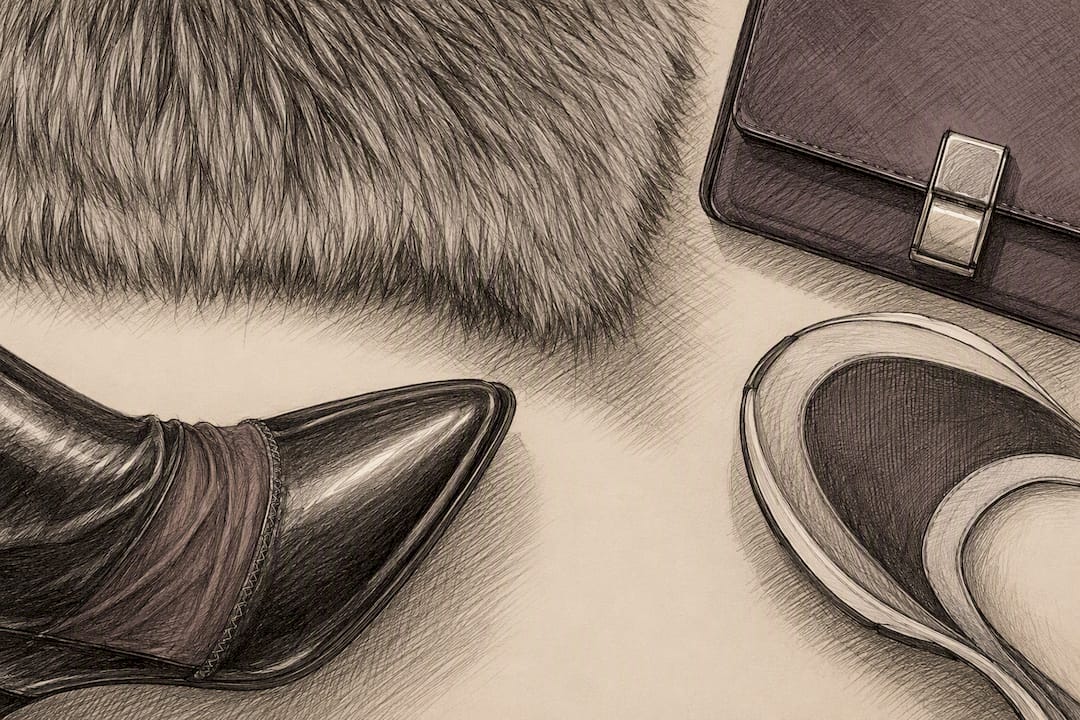
Bag shape matters more than most people realize. Structured leather bags or geometric shapes read polished against a soft coat, while soft, fuzzy hobo bags tend to compete with the fur instead of complementing it. A structured faux fur shoulder bag can actually work in fur’s favor when it contrasts in shape, even if it shares the material.
Skip fur-on-fur. Pairing a fur hat with a fur coat tends to look costume-like rather than intentional, so reach for a wool cap or a leather-trimmed beanie instead. Stylist Danielle Cafiero suggests grounding a fur coat with something casual, like sneakers or a baseball cap, for a high/low combination that feels current rather than fussy.
- Structured bags and contrasting hats keep the look modern.
- Minimal jewelry lets the coat stay the focal point.
- One casual element (sneakers, a cap) balances an otherwise dressed-up piece.
How to Choose Quality Faux Fur and Keep It Looking New
Not all faux fur is built the same, and the difference shows up fast. Look for even, dense pile, a substantial lining, defined shoulder structure, and seams that don’t pull or gap.
Cheap faux fur usually gives itself away through matted pile, an unnatural shine, or a thin, flimsy lining that lets cold air through. Well-made faux fur, on the other hand, actually traps air between the fibers, which gives it real insulating warmth close to natural fur, according to Farfetch’s style guide on faux fur materials.
Basic care keeps a good coat good for years:
- Store on a wide hanger, never a hook, to protect the shoulder shape.
- Skip plastic garment covers, which can flatten and mat the pile over time.
- Brush gently in the direction of the fur to keep it looking full.
- Spot-clean small marks and leave bigger stains to a professional cleaner who works with faux fur specifically.
Meet the Stylist Behind This Guide
This guide comes from Latoya at Primadonsanddonnas, with a background that includes.
Certain brands build faux fur pieces made-to-order, in various sizes, with sustainability considered in the material choice. Readers wanting the fuller picture on the category can start with what a faux fur coat actually is or compare it directly to real fur trade-offs. For more on how personalization fits into the sustainability conversation, see this piece on faux fur fashion and customization.
Mixing Faux Fur With Leather, Denim, and Prints
Faux fur wasn’t built to stand alone, and the strongest outfits treat it as one texture in a mix, not the whole story. Leather is the most reliable partner. A leather skirt, pants, or jacket underneath a fur piece creates the kind of contrast stylists keep coming back to: one smooth surface, one voluminous one, and nothing fighting for attention.
Denim works almost as well, and it’s the lower-effort option for daytime. A cropped faux fur jacket thrown over a denim jacket, or straight over jeans and a tee, keeps the whole outfit grounded and wearable instead of costume-y. The trick is texture balance again: denim’s flat weave gives the fur something to visually rest against.
Prints take more care. A leopard or checkered faux fur piece needs a strictly solid base, ideally in black or camel, so the eye has somewhere to land. Two patterns in one outfit, even a subtle stripe paired with animal print fur, usually reads as cluttered rather than intentional. If you’re wearing a printed coat, save the prints elsewhere in your closet for a different day.
Suede sits between leather and denim in formality and pairs especially well with shaggy or long-pile fur, since both have texture but in different registers. Wool trousers or a wool blazer underneath a faux fur vest also works, particularly for office or smart-casual days when leather feels like too much. The rule across all of it: one textured, high-impact fabric per outfit. Faux fur claims that slot every time, so everything else gets to be quiet.
Layering Faux Fur for Cold, Cool, and In-Between Days
Layering is where faux fur earns its versatility across seasons, not just as a heavy winter topper. In the coldest months, a longline coat goes over a chunky knit sweater and a base layer, giving you real warmth without sacrificing shape, since the coat’s structure holds even with bulk underneath.
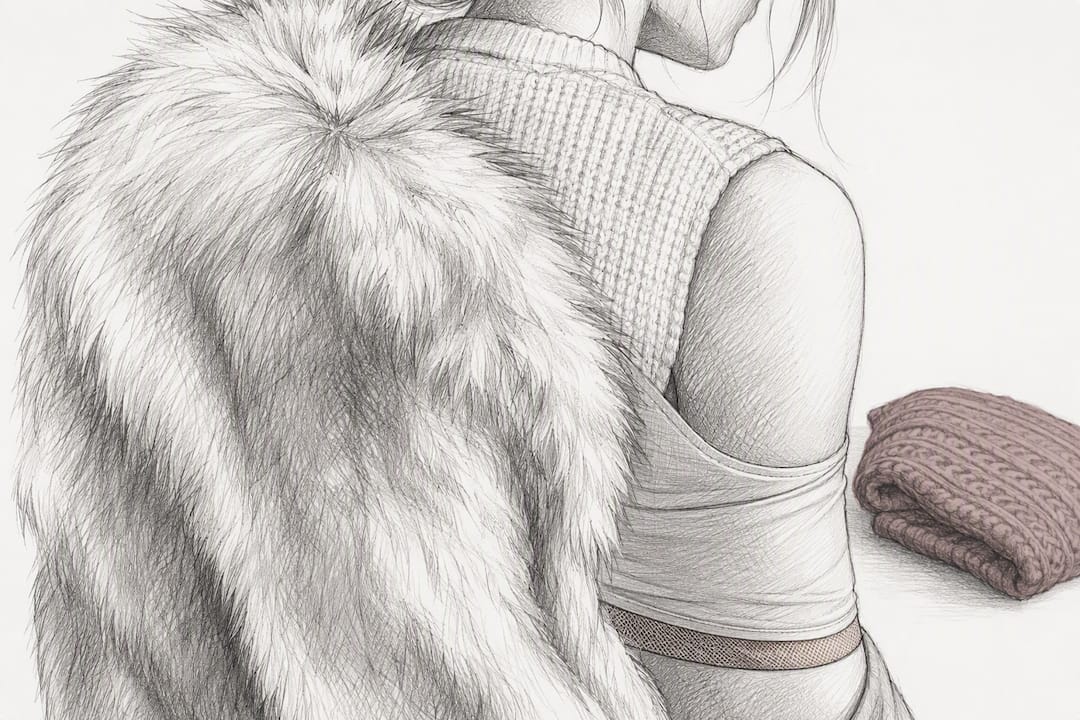
In fall and early spring, the vest becomes the workhorse. Worn over a thin turtleneck or a button-down, it adds texture and a bit of warmth without the commitment of sleeves, which makes it easy to remove indoors without disrupting the outfit. A fur-trim jacket does similar work for transitional weather, letting you layer a hood or collar detail over a simple hoodie or blazer.
For travel days specifically, faux fur vests layer especially well over lightweight base pieces like a fitted crewneck, since they add warmth in transit without the weight of a full coat in a carry-on. Cropped jackets layer nicely over turtlenecks and under a scarf for city days with unpredictable temperature swings.
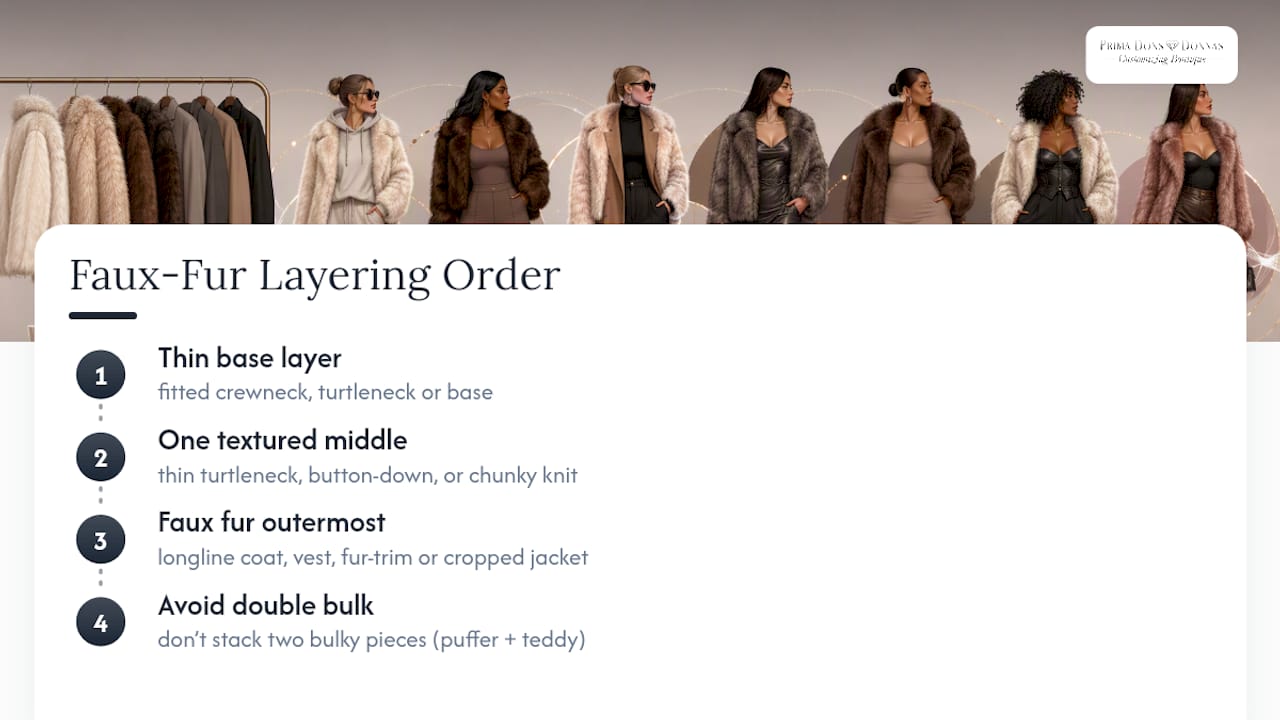
The general order that works: thinnest layer closest to the body, faux fur as the outermost or near-outermost piece, and no more than one other textured layer in between. Stacking two bulky pieces, like a puffer under a teddy coat, usually looks bigger than intended. Keep one layer doing the volume work and the rest doing the shape work.
Faux Fur’s Place in a Modern Wardrobe
Faux fur earns its spot in 2026 wardrobes because it balances a statement with a conscience, offering the visual impact of fur without the material’s ethical baggage. Start with a neutral or cropped piece before committing to a dramatic longline. If sustainability and fit matter to you, a made-to-order option gives you both without settling for whatever a rack happens to carry in your size.
— Latoya
Shop Ready-to-Ship and Custom Faux Fur With Primadonsanddonnas
Some brands offer made-to-order faux fur pieces in multiple sizes and colors to provide a better fit than generic size charts.
The Fur Collection covers everything from vests to statement coats, and the Custom Outerwear Collection lets you specify length, color, and fit details before it’s built. If you need something faster, the Ready to Ship line skips the custom timeline entirely. Add-ons like Express Shipping ($103) or a Rush Processing Add-On ($128) are available on the customization options page for anyone working against a deadline, whether that’s a wedding, a concert, or a lunch date that snuck up fast. Sizing details and lead times are listed on each product page. Browse the collections and start building your piece.
Sources
For deeper stylist guidance, The Zoe Report’s coat styling piece covers outfit formulas straight from working stylists. StyledMood’s 2026 roundup offers color and texture matrices worth bookmarking. Farfetch’s style guide explains the material improvements behind modern faux fur.
- How To Style A Faux Fur Coat This Winter, According To Stylists — The Zoe Report
- Faux Fur Coats outfit ideas: How to style them in 2026 — StyledMood
- All you need to know about faux fur — Farfetch Style Guide
FAQ
How Do You Style a Faux Fur Coat?
Keep the base simple and fitted, then let the coat carry the visual weight. Pair a cropped style with high-waisted jeans and sneakers for daytime, or drape a longline coat over a slip dress for evening.
Is Faux Fur Still in Style?
Yes. Seasonal trend roundups and editorial coverage continue to feature faux fur heavily heading into 2026, and its role has shifted from a niche alternative to a mainstream outerwear category on its own.
What Are the Downsides of Faux Fur?
Lower-quality faux fur can mat, develop an unnatural shine, or lose shape faster than well-made pieces, especially with thin lining or loose seams. Choosing a coat with dense pile and solid construction, like the pieces built through Primadonsanddonnas’s made-to-order process, avoids most of these issues.
What Colors Work Best for a First Faux Fur Piece?
Black is the most versatile starting choice, with camel and cream close behind for pairing ease. These neutrals work with denim, leather, and knitwear alike, which makes them the easiest colors to build a wardrobe around.
Can Plus-Size Women Wear Longline Faux Fur Coats?
Yes, and a knee-length or longer cut often balances curvier frames better than a short crop. Defining the waist, either through the coat’s cut or a belt worn over it, helps keep the silhouette intentional rather than shapeless.


Leave a comment