

Plus Size Fixes: Stop Thigh High Boots Slipping in Five Minutes
Fashion tape or silicone grip strips fix thigh-high boots slipping in under two minutes, and thigh-high socks or leggings add instant friction if you need a no-adhesive option. Both are temporary. If your boots slide every single time you wear them, the real fix is fit: a cobbler alteration or a custom shaft measurement from a made-to-order brand. Always patch-test any adhesive first, and never wrap anything tight enough to cut circulation.
TL;DR:
- Temporary fixes like textured socks or folding the top of the boots can hold for a night but do not address underlying fit issues.
- Moisture, leg shape, and material type significantly influence how well thigh-high boots stay in place, especially during extended wear.
- Adhesive solutions such as fashion tape or silicone grip strips require patch testing and proper application to prevent skin irritation and ensure effectiveness.
- Custom alterations by a cobbler or made-to-order boots based on precise measurements are the most effective long-term solutions for persistent slipping.
- For on-the-go emergencies, keep a kit with fashion tape, silicone patches, hair ties, safety pins, and double-sided tape for quick fixes during extended wear.
Table of Contents
- Why Do Thigh High Boots Slip in the First Place?
- Quick Wearable Fixes to Try Right Now
- Adhesives and Grip Products: Tape, Glue, and Silicone Strips
- Support Accessories: Boot Bras, Garters, and Velcro
- Choose or Alter Boots So They Naturally Stay Up
- What a Cobbler Can Actually Fix (And What It Costs You)
- Your On-the-Go Repair Kit for Thigh High Boots Falling Down
- Prima Dons and Donnas: Built-In Fit for Boots That Actually Stay Up
- A Stylist’s Take on Fit Over Fixes
- Get Boots Made to Fit, Not Boots You Have to Fight
- Sources
- FAQ
Why Do Thigh High Boots Slip in the First Place?
Boots slip because the shaft circumference is bigger than your thigh, and gravity does the rest. Most ready-to-wear thigh-high boots are cut for a narrow range of thigh, calf, and ankle proportions, so if your leg falls between sizes, or your thigh is noticeably smaller than your calf, the excess material has nowhere to go but down.
Moisture makes it worse. Humidity, sweat, or even the natural oils on your skin reduce friction between the boot’s lining and your tights or bare leg, which is why boots that stay put in a cool store can slide by the second hour at a warm venue. Shaping matters too: a boot with a straight shaft on a curvier thigh loses grip fast, while a boot with built-in contouring holds better even at a slightly looser fit.
Once you understand the cause, the fix gets a lot easier to pick. Temporary hacks solve the friction and gravity problem for one night. Fit and alteration solve the sizing mismatch for good, which is the difference between a quick patch and a real thigh high boots slipping solution.
Quick Wearable Fixes to Try Right Now
Before you buy anything, work with what’s already in your closet. These fixes take five minutes and cost nothing extra.
Thigh-high socks, tights, or leggings. Texture beats smooth every time. A ribbed or textured thigh-high sock grips the boot’s lining far better than bare skin or sheer stockings, and it’s the fix wikiHow’s guide to keeping boots up recommends first for exactly that reason. Leggings work the same way under pants.
Folding the top down. A slight fold shortens the shaft and tightens the fit at the point of contact, which helps a lot with structured leather or faux leather. Skip this trick on suede. Folding creases the nap permanently and can leave a visible line that never smooths back out.
Pull ties, laces, or hair ties. Sew a loop of elastic or ribbon inside the top of the boot, then loop it around a belt loop or garter clip. A plain hair tie or a doubled rubber band works in a pinch as a discreet internal anchor, especially if you’re testing whether tightening the top even solves your slipping before you commit to a real accessory.
Which fix to reach for depends on what you’re wearing over the boots. Under a skirt or dress, an internal tie or a boot bra stays hidden and does the heavy lifting. Under pants, folding or a sock liner is usually enough since the pant leg hides any bulk.
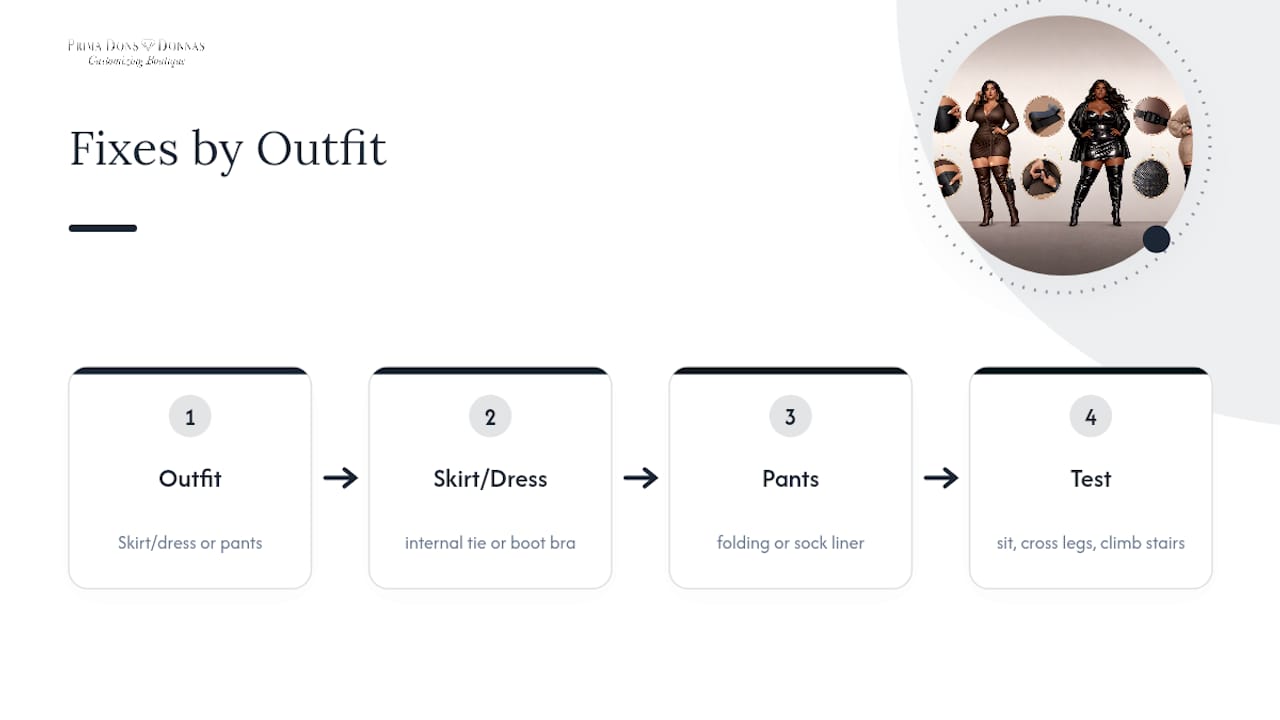
Pro Tip: Test your fix while sitting down, not just standing. Boots slip most when you sit, cross your legs, or climb stairs, so a fix that holds while you stand at a mirror can still fail on the dance floor.
Adhesives and Grip Products: Tape, Glue, and Silicone Strips
Three products solve slipping through different mechanics, and mixing them up wastes money. Fashion tape sticks to fabric, not skin, and works best when your boots go over tights or leggings. Fashion glue is a body-safe adhesive made to sit directly on skin, and it holds tighter but demands more care. Silicone strips attach to the inside of the boot shaft itself, so they’re reusable and never touch your skin at all.
Here’s how to apply each one correctly:
- Patch-test first. Apply a small amount of glue or a short strip of tape to your inner forearm and wait 24 hours before using it on your leg. WikiHow’s guide on preventing slouching flags this step as essential, since skin sensitivity varies widely from person to person.
- Skip lotion and oil beforehand. Both weaken adhesive bond within minutes, so apply tape or glue to clean, dry skin or fabric only.
- Apply in short strips, not one long piece, so you can peel and reposition without wasting the whole strip.
- Remove slowly, pulling in the direction hair grows if you’re using glue on bare skin. Pulling against the grain causes irritation and can pull hair out.
- Store silicone strips flat between wears so they keep their tack instead of curling at the edges.
When shopping, look for labels that say “skin-safe,” “removable,” and “hypoallergenic.” Regular household glue or duct tape is not a substitute. Community-shared hacks like hot glue applied straight to skin circulate widely online, but a safer, tested version, like a reusable silicone patch, gets you the same hold without the burn risk or the skin damage.
Support Accessories: Boot Bras, Garters, and Velcro
A boot bra is a fabric or elastic band that wraps around your thigh just above the boot’s top edge, holding the shaft snug against your leg from the inside. You can buy one, or make your own from a wide elastic band and a strip of sew-on Velcro, adjusted to your exact thigh measurement.
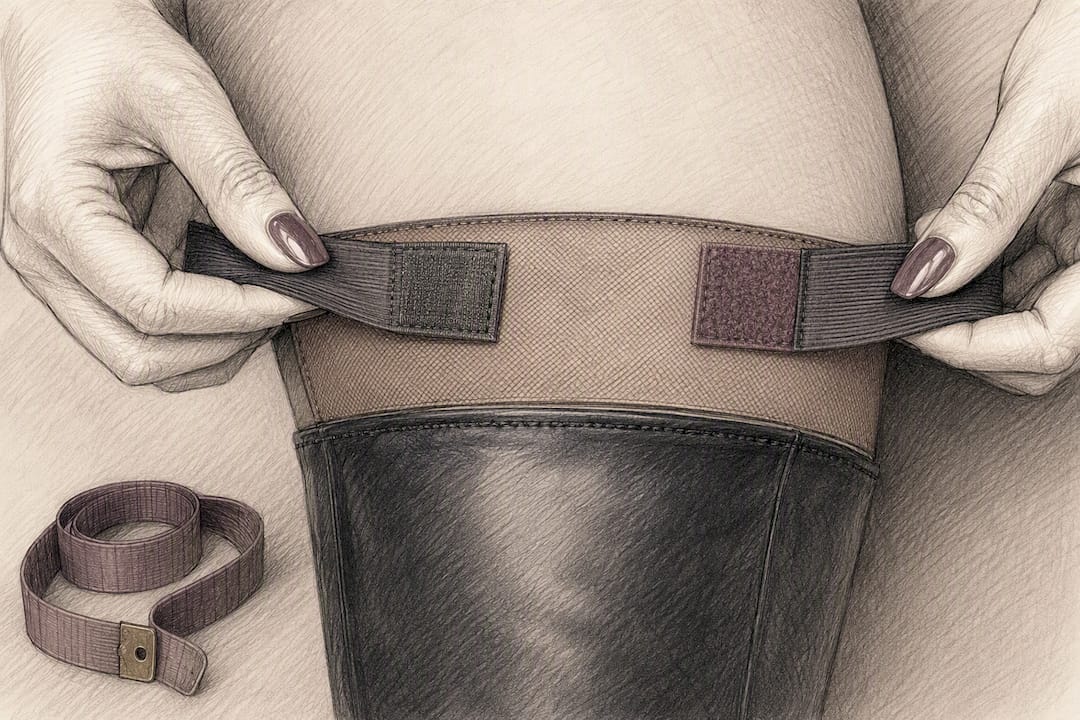
Garter-style systems work differently. Instead of gripping the boot from inside, they clip to loops sewn onto the boot’s rear and connect to a garter belt worn under your skirt or dress, similar to how Suzanne Carillo’s boot styling guide describes attaching ribbon loops that clip to a garter. This route works best with skirts and dresses since the garter belt needs to stay hidden under the hem.
For DIY Velcro fixes:
- Sew one side of a Velcro strip to the inside top of the boot shaft.
- Sew the matching strip to a fabric band sized to your thigh.
- Press the two together once the boot is on, adjusting tension until it holds without pinching.
- For permanent loops instead of sewn Velcro, a cobbler can add reinforced stitching that won’t tear loose with repeated wear.
Pro Tip: You should be able to slide two fingers under any strap or elastic band comfortably. If you can’t, it’s too tight, and a too-tight band cuts circulation faster than a loose boot ever slips.
Choose or Alter Boots So They Naturally Stay Up
Material is half the battle. Suede and textured leather grip your tights or skin through natural friction, while glossy synthetic materials tend to slide no matter how well they otherwise fit. If you’re shopping for a new pair specifically to solve a slipping problem, prioritize a textured or suede finish over a shiny patent look, a detail borne out repeatedly in material comparisons for boot fit.
Measuring correctly matters just as much as material. Measure your thigh circumference at its widest point, usually two to three inches below where you want the boot to sit, then measure your calf and ankle too. A boot that’s snug at the calf but loose at the thigh will always slip, because the widest part of your leg is where slipping starts.
| What to measure | Where | Why it matters |
|---|---|---|
| Thigh | Widest point, 2 to 3 inches below the top edge | Determines whether the shaft will hold or slide |
| Calf | Widest point of the calf muscle | Mismatched calf fit causes bunching that speeds up slipping |
| Ankle | Narrowest point above the foot | Affects how the boot sits when you walk or bend |
If your thigh measurement falls outside a standard size chart, or your calf-to-thigh ratio is significantly different from the “average” a brand designs for, made-to-order or wide-calf boots solve the problem at the source instead of patching around it. Some brands build boots to your actual measurements rather than a standard size run, which is worth exploring if you’ve swapped sizes twice already and still get slipping. Speaking of which, if you’ve already exchanged once and the new size still isn’t right, stop exchanging and start looking at custom sizing or alterations instead. That’s usually a fit issue, not a sizing issue.
What a Cobbler Can Actually Fix (And What It Costs You)
A cobbler solves the root cause that tape and socks only mask. For boots you plan to wear for years, alterations are worth the investment.
Common services include tightening the shaft by taking in the seam along the back or side, adding an interior elastic panel that lets the boot stretch to slide on but grip once worn, sewing in fabric or ribbon loops for garter attachments, and adding a thin silicone liner strip to the inside for extra tack.
- Ask for a written estimate before any work begins. Shaft alterations vary by material and boot construction.
- Request to see photos of similar past work, especially for suede or exotic materials that are harder to repair invisibly.
- Reserve professional alterations for investment boots you wear often. A $20 pair from a fast-fashion clearance rack rarely justifies a $40 to $60 repair bill.
- After alteration, avoid machine washing or soaking the altered seam, and let a cobbler know if the fix loosens over time so they can adjust it under any workmanship guarantee they offer.
Alterations make the most sense when you’ve already tried tape, socks, and ties and you’re still adjusting your boots every twenty minutes. That’s the sign a temporary fix has hit its limit.
Your On-the-Go Repair Kit for Thigh High Boots Falling Down
Pack a small kit before any event where you’ll be on your feet for hours. Keep it in your bag, not your car, since you’ll want it fast.
- Two strips of fashion tape, individually wrapped so they don’t stick to each other.
- One spare silicone patch, rolled in wax paper to keep it clean.
- Two hair ties or rubber bands for a fast internal anchor.
- A couple of small safety pins, useful for pinning a loose lining back in place.
- A small roll of travel double-sided tape as backup if your fashion tape runs out.
Test any fix in the bathroom or your car before you walk back out. A quick squat or a few steps in place tells you if it holds. Under a skirt or dress, tuck extras into an internal tie so nothing shows. Under pants, a quick tape fix at the ankle or knee is invisible either way.
Prima Dons and Donnas: Built-In Fit for Boots That Actually Stay Up
Some brands design thigh-high boots as made-to-order pieces, built to your actual thigh, calf, and ankle measurements rather than a standard size run. That’s the difference between patching a fit problem every time you wear the boots and never having the problem at all.
Custom shaft measurements mean the boot follows your leg’s actual shape instead of a generic curve, and interior finishes like a faux-suede lining add the same grip advantage covered earlier, without you needing tape or a sock every time. The brand’s step-by-step guide to keeping thigh-high boots up walks through the same DIY fixes covered here, tailored to the brand’s own boot styles. For plus-size and wide-calf shoppers specifically, the guide to thigh-high boots that actually fit breaks down exactly what measurements to check before you order.
A Stylist’s Take on Fit Over Fixes
Great style and constant readjustment don’t have to coexist. A boot that fights you all night isn’t a styling win, no matter how good it looks in a photo at the door. Fit is what makes a bold outfit feel effortless instead of high-maintenance.
Try the cheap fixes first. Tape, socks, and a hair tie tell you fast whether your issue is minor friction or a real fit mismatch. If you’re still adjusting after trying two or three temporary fixes, that’s information, not failure. It means your leg proportions need a boot built around them, not a boot you’re constantly wrestling into shape.
— Latoya
Get Boots Made to Fit, Not Boots You Have to Fight
Some made-to-order brands build thigh-high boots and outfits around your measurements instead of requiring you to fit into standard sizes. That’s the real advantage over buying off-the-rack and hoping tape gets you through the night: a made-to-order shaft solves the slipping problem before you ever put the boot on.

Browse the faux fur and leather boot collection for ready-to-ship styles built with grip-friendly materials, or start a custom order through the made-to-order collection if you want boots and an outfit measured specifically for you, whether it’s for a wedding, a concert, or a lunch date where you need to look sharp without checking your boots every ten minutes. Send in your thigh, calf, and ankle measurements and skip the guesswork of standard sizing entirely.
Sources
- How to Keep over the Knee Boots Up: 9 Steps (with Pictures) - wikiHow
- Keep Thigh High Boots From Falling Down - Suzanne Carillo
FAQ
How Do I Stop Thigh-High Boots From Sliding Down?
Fashion tape, a silicone grip strip, or a textured thigh-high sock solves most slipping within minutes; for boots that slip every wear, a cobbler alteration or custom shaft sizing fixes the underlying cause.
How Do I Stop Thigh Highs From Slipping Under Pants?
Layer a textured sock or legging underneath for grip, or fold the boot top down slightly to tighten the fit at the point of contact, skipping the fold on suede to avoid creasing.
How Can I Make Thigh-High Boots Fit Tighter Without Buying New Ones?
Add an interior elastic tie, a DIY boot bra made from elastic and Velcro, or a strip of fashion tape along the inside shaft; for a lasting fix, ask a cobbler about tightening the seam.
Why Won’t My Thigh Highs Stay Up No Matter What I Try?
Your thigh circumference likely doesn’t match the boot’s shaft size, which is common when calf and thigh proportions differ from a standard size chart; made-to-order boots from a brand like Primadonsanddonnas solve this by building the shaft to your exact measurements.


Leave a comment