

Choose Statement Sunglasses That Block UVA and UVB: Check for UV400
UV400 means the lenses block ultraviolet radiation up to 400 nanometers, covering both UVA and UVB rays and delivering close to 100 percent UV protection. That single spec matters more than tint, price, or brand. For shoppers, the verdict is simple: look for the words “UV400” or “100% UV protection” on the label, and treat polarization as a separate, optional feature.
TL;DR:
- UV400 lenses block ultraviolet light up to 400 nanometers, covering both UVA and UVB rays, and offer almost complete UV protection.
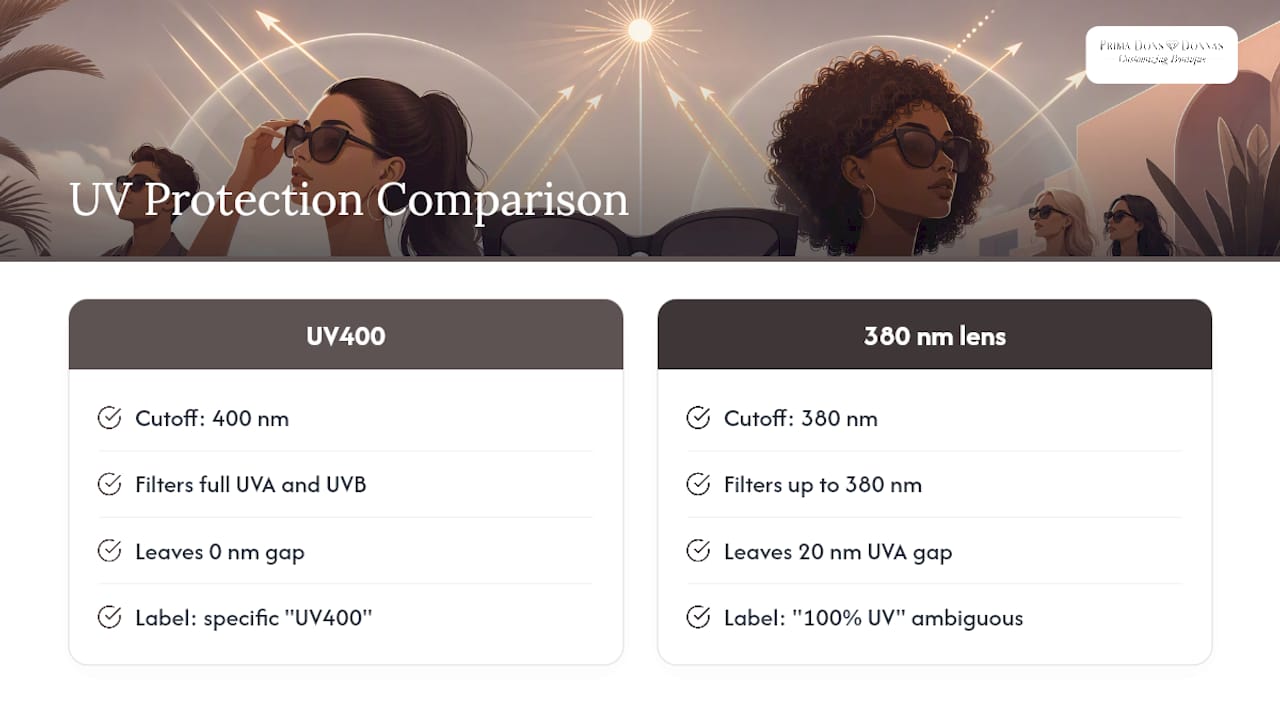
- The “UV400” standard ensures full UVA and UVB filtering, unlike older labels claiming “100% UV,” which often left a 20 nanometer gap.
- Polarized lenses reduce glare but do not necessarily provide UV protection, so both features must be confirmed separately.
- Checking labels or asking an optician with a UV meter is the quickest way to verify if sunglasses truly meet the UV400 standard.
- Frame shape and fit, especially wraparounds, are crucial for protecting eyes from peripheral UV rays, especially for children.
Table of Contents
- What Does UV400 Sunglasses Meaning Actually Cover?
- Why UV400 Beats Older ‘100% UV’ Label Language
- UV400 vs Polarized Sunglasses: What Each One Actually Does
- How to Check If Your Sunglasses Are Really UV400
- Tint, Coverage, and Buying Sunglasses for Kids
- Expert Guidance Behind Every Pair Prima Dons and Donnas Designs
- Balancing Eye Safety With Fashion
- Shop Sunglasses That Match Your Statement Style
- Sources
- FAQ
What Does UV400 Sunglasses Meaning Actually Cover?
Ultraviolet light comes in three bands. UVA runs roughly 315 to 400 nanometers, UVB spans about 280 to 315 nanometers, and UVC sits below that but rarely reaches the ground because the atmosphere absorbs almost all of it. The World Health Organization) outlines these ranges and the health risks tied to overexposure, from sunburned corneas to long-term cellular damage.
A lens labeled UV400 blocks light across that entire span up to 400 nanometers, which means it catches both UVA and UVB in one shot instead of filtering just part of the spectrum. That distinction matters because both bands do damage, just on different timelines.
UVB causes photokeratitis, essentially a sunburn on the cornea that shows up within hours of intense exposure. UVA penetrates deeper and builds cumulative harm over years, contributing to cataracts and age-related macular degeneration. A PubMed review on ocular photodamage documents this link between chronic UV exposure and disease risk in the eye. Cataracts alone are a leading cause of vision loss worldwide, and unlike a sunburn, you don’t feel UV damage happening in real time. That’s what makes UV400 sunglasses meaning worth understanding before you buy, not after a diagnosis.
Why UV400 Beats Older ‘100% UV’ Label Language
Sunglasses sold as “100% UV protected” aren’t always lying, but the phrase used to get attached to lenses that only filtered up to 380 nanometers. That leaves a 20 nanometer gap of unfiltered UVA sneaking through, right where some of the more damaging long-wave rays live.
UV400 closes that gap. According to Lensmart’s breakdown of the two claims, a lens rated to 400 nanometers filters the full UVA and UVB range, while a 380-rated lens leaves a measurable slice of ultraviolet light untouched. The numbers look close on paper, but that gap is exactly where consumer confusion starts.
Industry standards like ISO 12312-1 and various ANSI references exist to standardize how lenses get tested and labeled, though wording still varies by manufacturer and country. Your safest move: skip vague marketing language entirely and look for the specific phrase “UV400” or “blocks up to 400 nm” printed on the sticker, hangtag, or product spec sheet. If a listing only says “UV protective” with no number attached, ask before you buy.
UV400 vs Polarized Sunglasses: What Each One Actually Does
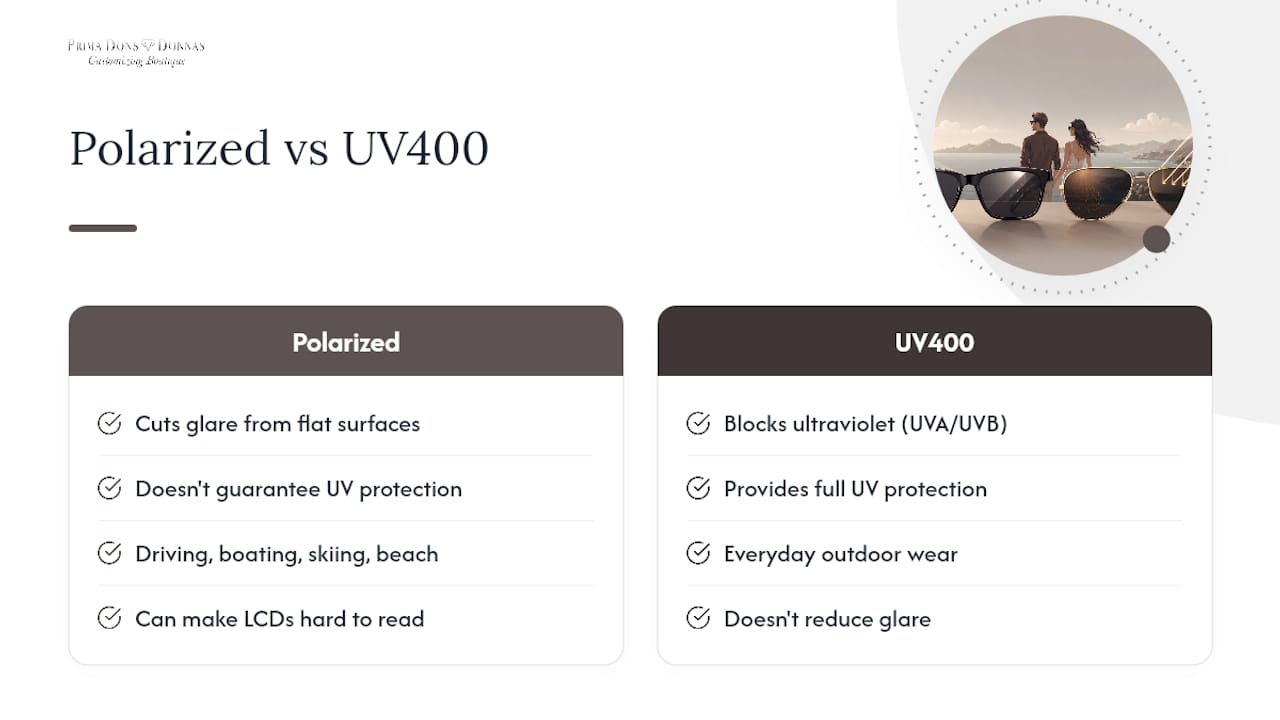
Polarization and UV protection solve two completely different problems, and mixing them up is one of the most common mistakes shoppers make. Polarized lenses use a special filter that cuts glare bouncing off flat, reflective surfaces like water, snow, pavement, and car hoods. That’s it. Polarization has nothing to do with blocking ultraviolet light.
A review of ocular photodamage research confirms that polarizing filters and UV filters are engineered independently. A pair of sunglasses can be polarized without being UV400, and plenty of cheap polarized lenses on the market skip UV protection entirely.
For everyday wear and casual outdoor use, UV400 alone provides adequate protection. Polarization earns its keep during driving, boating, skiing, or beach days, where glare off water or snow strains your eyes and creates real visibility problems. One caveat worth knowing: polarized lenses can make LCD screens on phones, dashboards, and ATMs harder to read at certain angles, so consider that trade-off before choosing polarized for daily use.
How to Check If Your Sunglasses Are Really UV400
Don’t trust dark tint or a high price tag to tell you anything about UV protection. Verification takes about thirty seconds.
- Check the sticker, hangtag, or printed spec sheet for the exact phrase “UV400” or “100% UV protection.”
- Look up the product page online if the physical label is missing or worn off.
- Ask an optician to test the lenses with a handheld UV meter, a quick, reliable way to confirm actual transmission rather than trusting the packaging. All About Vision notes this is a common in-store service and takes just a minute per pair.
- Be wary of sellers, especially fashion-only retailers or street vendors, who can’t answer a direct question about UV rating.
Pro Tip: If a listing shows a tinted lens but zero mention of UV400 anywhere in the description, treat that as a red flag rather than an oversight. Legitimate eyewear brands print this spec because customers ask for it.
Tint, Coverage, and Buying Sunglasses for Kids
Dark lenses feel protective, but tint only affects visible light comfort, not ultraviolet filtering. A pale amber lens can carry full UV400 protection while a nearly black lens offers none. The American Academy of Ophthalmology is direct about this: lens darkness tells you nothing about UV blocking, so check the label instead of judging by eye.
Frame shape matters too. Wraparound styles and larger lenses block peripheral UV rays sneaking in from the sides, which flat, narrow frames miss entirely.
Kids need this protection earlier than most parents realize. Their eyes let more UV light reach the retina than adult eyes do, and early, consistent exposure adds up over a lifetime. The Vision Council recommends UV400 sunglasses starting in early childhood, with a snug, secure fit that won’t slide during play.
Expert Guidance Behind Every Pair Prima Dons and Donnas Designs
Eye-health guidance from the World Health Organization and the American Academy of Ophthalmology shapes how Primadonsanddonnas thinks about accessories, not just how they look, but what they actually do for your eyes. Statement sunglasses shouldn’t force a trade-off between style and safety.
The Crystal Rhinestone Sunglasses collection reflects that balance: bold, embellished frames built for a night out or a photo-ready lunch date, without skipping the UV400 standard that actually protects your eyes. Whether you’re shopping for a ready-to-ship pair or a custom fit, checking that UV400 wording stays part of the decision, right alongside color and shape.
Balancing Eye Safety With Fashion
UV400 sunglasses meaning isn’t a footnote for people who buy statement frames. Bold rhinestone styles and oversized shapes get worn outdoors, at concerts, on patios, exactly where UV exposure adds up. Protection and personality aren’t competing priorities.
Choose frames with real coverage, check the label, then let the design do the rest. Good style was never the trade-off.
— Latoya
Shop Sunglasses That Match Your Statement Style
Primadonsanddonnas gives you a route most sunglass shelves don’t: custom sizing and color options on statement frames, so you’re not stuck choosing between a pair that fits your face and one that fits your personality. Every pair in the Crystal Rhinestone Sunglasses line pairs bold, embellished design with practical UV400 protection, ready to ship fast when you need them for a concert, a lunch date, or a weekend event.
Browse the sunglasses collection to find a pair that fits your next occasion, or pair your new shades with a piece from the made to order dress collection for a full custom look. If you’re planning outfits around outdoor plans, this outdoor accessories buying guide is worth a look for what else to pack. Place your order today and get eyewear that’s ready when your plans are.
Sources
FAQ
Is Polarized Better Than UV400?
Neither is “better” because they solve different problems. Polarization cuts glare off flat surfaces like water or snow, while UV400 blocks ultraviolet radiation, and the two features work independently of each other.
Is UV400 Good Enough for Sunglasses?
Yes. UV400 blocks nearly the entire UVA and UVB range, which the American Academy of Ophthalmology considers the benchmark for adequate everyday and outdoor eye protection.
Can Sunglasses Be Both UV400 and Polarized?
Yes, many lenses combine both features, and that combination is ideal for driving, boating, skiing, or any activity involving glare off water, snow, or pavement.
How Do I Know If My Sunglasses Are UV400?
Check the label, hangtag, or product spec sheet for the exact wording “UV400” or “100% UV protection,” or ask an optician to test the lens with a handheld UV meter for a direct reading.
Does a Darker Lens Mean More UV Protection?
No. Tint affects how much visible light gets through for comfort, not UV filtering, so a light-colored lens can carry full UV400 protection while a dark lens offers none.


Leave a comment