

3 Material Truths About Vegan Fur and How to Verify Them for Shoppers
Vegan fur is a fur-like textile made without animal inputs, built either from synthetic fibers or plant-based materials, and worn as a cruelty-free stand-in for real fur. It rules out any product tied to animal farming, trapping, or slaughter. That said, “vegan” describes the ethics of a fabric, not its environmental footprint. A synthetic vegan fur and a plant-based one can land in very different places once you factor in pollution, biodegradability, and how long the piece actually lasts in your closet.
TL;DR:
- Vegan fur is primarily made from synthetic plastics or plant-based materials, with plant-based options still scaling up and being more expensive.
- Microplastic shedding from synthetic vegan furs remains a major environmental concern, regardless of their animal-free claim.
- Certifications like PETA-Approved Vegan and Vegan Trademark are essential to verify a product is truly animal-free, as labels often omit details about trims or adhesives.
- Longevity and proper care of vegan or faux furs significantly reduce environmental impact, with well-maintained pieces lasting years and avoiding frequent replacements.
- Brands offering made-to-order vegan fur outerwear help reduce overproduction and ensure the garment’s animal-free status before purchase.
Table of Contents
- What Vegan Fur Meaning Actually Covers: Vegan Fur vs. Faux Fur vs. Real Fur
- What Is Vegan Fur Made Of? Materials and How They’re Built
- The Ethics vs. Environment Question: Cruelty, Microplastics, and Lifecycle Thinking
- How to Verify a Product Is Truly Vegan Fur
- Caring for Vegan and Faux Fur So It Actually Lasts
- How Prima Dons and Donnas Approaches Vegan and Faux Fur
- Where the Vegan Community Actually Lands on This
- Shop Cruelty-Free Fur: Made-to-Order Options at Prima Dons and Donnas
- Sources
- FAQ
What Vegan Fur Meaning Actually Covers: Vegan Fur vs. Faux Fur vs. Real Fur
The terms get thrown around like synonyms, but they answer different questions. “Vegan” describes ethics. “Faux” or “fake” describes construction. “Real” describes origin. A fabric can be faux and still fail the vegan test, and that gap is where a lot of shoppers get misled.
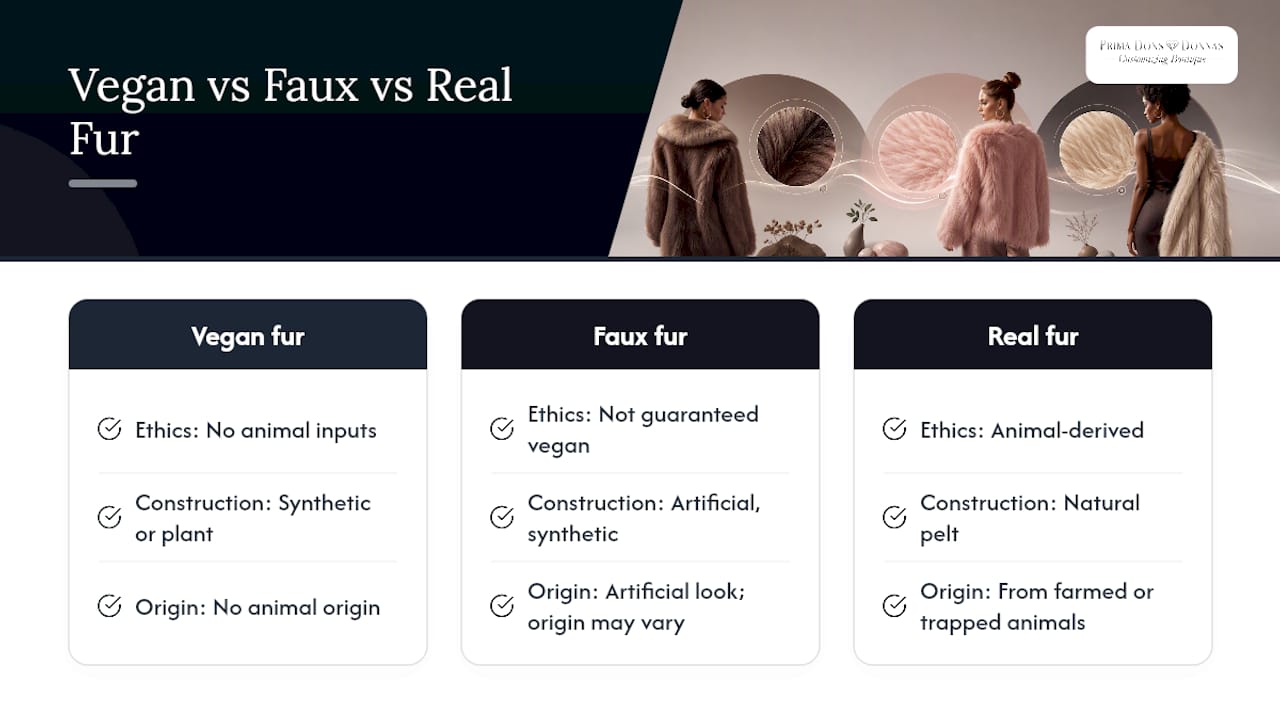
Real fur comes from farmed or trapped animals, full stop. It’s the category vegan fashion exists to avoid, and the reason terms like “cruelty-free” attach so tightly to fur alternatives.
Faux fur, by Cambridge Dictionary’s own definition, is simply artificial fur engineered to imitate the real thing. Most of it today is synthetic. Following the industry’s mid-20th-century shift away from animal fibers, manufacturers standardized on acrylic polymers, and modern fake fur is typically built from acrylics, modacrylics, polyester, or nylon. Here’s the catch: “faux” only tells you the fur look is fake. It says nothing about the glue holding the backing together, the trims stitched on, or whether reclaimed animal fur got blended in somewhere down the supply chain. Faux fur is usually vegan. It isn’t automatically vegan.
Vegan fur is the stricter label. Brands increasingly use it to draw a hard ethical line, and industry reporting notes the term now works as much as a marketing and ethical signal as a materials descriptor. When a brand says “vegan,” they’re making a specific promise: no animal-derived inputs anywhere in that piece, not just in the pile.
What Is Vegan Fur Made Of? Materials and How They’re Built
Vegan fur breaks down into three rough material families, and each comes with its own tradeoffs.
- Petrochemical synthetics. Acrylic, modacrylic, polyester, and nylon dominate the category, largely because they’re cheap, durable, and easy to dye into bold colors. The downside is that they’re plastic. They shed microplastics in the wash and outlast a landfill by decades.
- Recycled synthetics. Some manufacturers now spin faux fur from recycled polyester or reclaimed fibers, cutting virgin plastic use while keeping the durability synthetics are known for. It doesn’t solve the microplastic problem, but it lowers the raw material footprint.
- Plant-based and bio-based textiles. This is the newest and smallest category. Ecopel’s Flur is a 100% plant-based, biodegradable fur alternative, and the company positions it as distinct from ordinary faux fur rather than a variation on it. Similar startups claim their materials skip microplastics and cut emissions compared to petrochemical alternatives, though production is still scaling up.
Hidden animal inputs are the part shoppers miss most. Adhesives can contain animal-derived glycerin. Trims, linings, and buttons sometimes sneak in wool, leather, or bone. A coat can have a fully synthetic pile and still fail a strict vegan standard because of what’s stitched around it.
Pro Tip: Plant-based fur alternatives are still a small slice of the market, so expect a narrower color and style selection, and a higher price tag, until manufacturing scales up.
The Ethics vs. Environment Question: Cruelty, Microplastics, and Lifecycle Thinking
Every vegan fur clears the same low bar: no animal was farmed, trapped, or killed to make it. That’s the whole point of the category, and it’s the one thing every material family in the last section shares. Where they split apart is everything that happens after the animal-welfare question gets answered.
Petrochemical synthetics run on fossil fuel inputs and shed microplastic fibers every time they go through a wash cycle. Those fibers don’t biodegrade. They accumulate in waterways and, eventually, in the food chain. This is the tradeoff that catches a lot of vegan shoppers off guard: choosing an animal-free fabric doesn’t automatically mean choosing a low-impact one.
Plant-based alternatives aim to close that gap. They’re framed as lower-emission and microplastic-free, but the category is young, expensive relative to synthetics, and not yet available at the scale that mainstream fashion runs on. Academic researchers looking at ethical consumer behavior note the same pattern: shoppers consistently associate “vegan” with animal-free production, but the environmental impact of a vegan material still depends entirely on its specific composition and lifecycle, not on the vegan label itself.
So how do you actually choose? A simple framework helps.
- Prioritizing animal welfare above all else? Any vegan fur clears that bar, synthetic or plant-based.
- Trying to minimize microplastic pollution? Lean toward plant-based or recycled-content options over virgin acrylic.
- Trying to maximize garment longevity and lower your per-wear footprint? Durability matters more than the raw material category, which is why a well-made synthetic faux fur you wear for ten years can outperform a delicate bio-based piece you retire after one season.
None of these answers is wrong. They just optimize for different values, and knowing which one you’re optimizing for makes the shopping decision a lot faster.
How to Verify a Product Is Truly Vegan Fur
Labels lie by omission more often than they lie outright. A tag that says “faux fur” is telling you the outer look is fake. It isn’t certifying the whole garment is animal-free.
Two certifications do that certifying for you: PETA-Approved Vegan and the Vegan Trademark. Both require brands to document that no animal-derived materials or animal testing touched the product, which takes the guesswork off your plate.
When there’s no certification, work through this checklist before you buy:
- Scan the fabric content for wool, silk, or “fur trim” listed separately from the main material.
- Watch for “reclaimed” or “recycled fur” language, which usually means real animal fur reused from another garment.
- Ask about adhesives, since some backing glues use animal-derived glycerin.
- Ask how trims, buttons, and linings are sourced, especially on coats with leather-look accents.
Consumer guides on vegan fashion flag this exact gap: a coat marketed as faux can still carry animal-derived components in places shoppers never think to check.
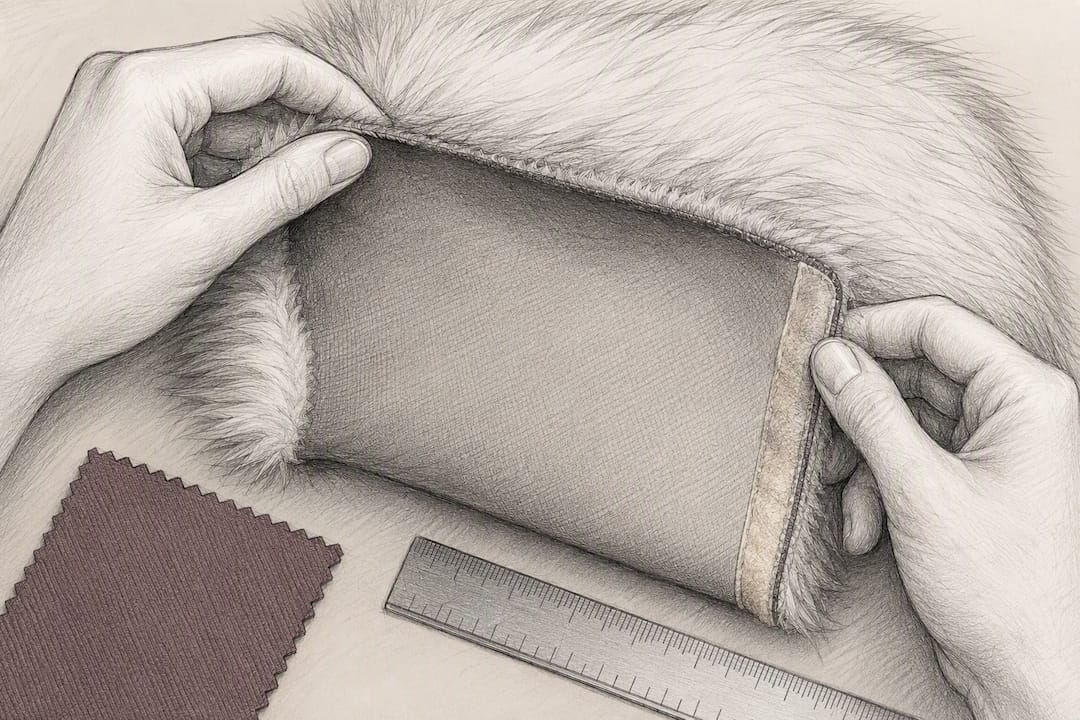
Pro Tip: Flip the garment inside out before buying. Cheap adhesive backing often looks glossy or slightly yellowed, while cleaner construction shows an even, matte finish, a quick visual cue that the piece was built with care.
Caring for Vegan and Faux Fur So It Actually Lasts
The most sustainable fur alternative is the one you keep wearing. A five-year-old faux fur coat that still looks sharp beats a “greener” piece that falls apart after one winter, every time.
- Spot clean instead of machine washing whenever possible. Full washes are what break down the pile and trigger microplastic shedding.
- Brush the fur gently with a wide-tooth comb after wear to keep it from matting.
- Store on a padded hanger with breathing room. Cramming a coat into a packed closet flattens the pile permanently.
- Save daily-wear pieces for lower-cost synthetics, and save your investment coat for special occasions like a concert, a lunch date, or a wedding guest look, where fit matters more than budget.
- Repair small tears or loose seams instead of replacing the whole coat, and look into local textile recycling programs once a piece is genuinely done.
A made-to-order fit extends a coat’s life on its own. A piece cut to your actual measurements gets worn more often and altered less, which quietly does more for your footprint than the fabric choice underneath it.
How Prima Dons and Donnas Approaches Vegan and Faux Fur
Some brands build faux-fur outerwear as made-to-order pieces, cut to your size and color rather than pulled off a generic size chart. That approach matters for plus-size shoppers especially, since standard faux-fur coats are notorious for stopping at a size that leaves half the market out.
Every faux-fur piece in the outerwear collection skips animal-derived fur entirely, and the brand’s editorial content, including contributions from writers like Latoya, walks shoppers through material questions like the ones covered above. If you’re unsure whether a specific coat’s trims or lining are animal-free, that’s a fair question to ask before you order, not after.
Where the Vegan Community Actually Lands on This
Vegan circles don’t fully agree on faux fur, and both sides make a fair point. Some argue any fur-look garment normalizes fur culture, animal-based or not. Others argue the visual distinction stopped mattering decades ago and cruelty-free imitation is a legitimate win on its own.
My honest read: choose plant-based or recycled-content vegan fur when it’s realistically available to you, and when it isn’t, choose the synthetic piece you’ll actually wear for years instead of one season. Longevity is the lever most shoppers overlook. Buy one coat you’ll keep instead of three you’ll replace.
— Latoya
Shop Cruelty-Free Fur: Made-to-Order Options at Prima Dons and Donnas
Built-to-fit beats built-to-guess, especially with outerwear you’re going to wear for years, not just one season. Some brands build every faux-fur coat and jacket as made-to-order, which means no overproduction sitting in a warehouse and no settling for whatever size happened to be left in stock.
Browse the custom outerwear collection for faux-fur coats built to your size and color, whether you need something for a winter wedding, a concert night out, or a lunch date that calls for a statement piece. Pair a fur-trimmed coat with a made-to-order dress for a full occasion-ready look, or check the boots collection for plus-size and custom-fit options that round out the outfit. If you want to confirm a specific piece is animal-free before you order, just ask through the product page. It’s a fair question, and it gets a straight answer.
Sources
- Faux Fur, Vegan Fur — Is There a Difference in Impact? (WWD)
- Fake fur — Wikipedia
- Ethical consumers’ awareness of vegan materials (MDPI)
FAQ
What Is the Downside of Vegan Leather?
Most vegan leather relies on petrochemical plastics like PVC or polyurethane, which don’t biodegrade and can release microplastics as they wear, similar to the tradeoff seen in synthetic vegan fur.
Can Vegans Wear Faux Fur?
Most vegans do wear faux fur, though some in the community argue it normalizes the look of animal fur regardless of material, so opinion within the community isn’t unanimous.
What Is the Most Fake Fur Made Of?
Most fake fur today is made from acrylic, modacrylic, polyester, or nylon, synthetic fibers that replaced animal-derived materials after the industry shift toward acrylic polymers in the mid-20th century.
Do Vegans Wear Wool or Silk?
No. Wool and silk both come from animals, sheep and silkworms respectively, so strict vegan standards exclude both, along with any fur trim or lining derived from them.
Is Vegan Fur the Same as Faux Fur?
Not always. Faux fur is usually vegan, but some faux-fur pieces include animal-derived adhesives, trims, or reclaimed fur, so checking labels or certifications like PETA-Approved Vegan confirms a piece is genuinely animal-free.


Leave a comment