

What Is Fashion Individualism and Why It Matters
TL;DR:
- Fashion individualism involves making style choices that reflect personal identity and values, not just following trends blindly. It emphasizes authentic self-expression through customized pieces and evolving styles that adapt to life rather than adhering to fixed aesthetics or chasing performative uniqueness. Ultimately, it is a dynamic process of building a personal wardrobe rooted in real meaning and self-awareness.
Fashion individualism is not about rejecting every trend you see. That misconception keeps a lot of people from understanding what is fashion individualism at its core. At its heart, it’s the conscious practice of making style choices that reflect your identity, values, and life story rather than simply following what everyone else is wearing. It sits at the intersection of psychology, culture, and personal confidence. And once you understand how it actually works, getting dressed stops feeling like a performance and starts feeling like a conversation you’re having with the world about who you are.
Table of Contents
- Key takeaways
- What fashion individualism really means
- How fashion individualism actually shows up
- The existentialist case for building your style
- Putting fashion individualism into practice
- Approaches to fashion individualism compared
- My take on fashion individualism
- Build your look with Primadonsanddonnas
- FAQ
Key takeaways
| Point | Details |
|---|---|
| Fashion individualism is a balance | It blends uniqueness with social belonging, not pure rejection of trends. |
| Psychology drives style choices | The desire to stand out and fit in both shape how you dress and why. |
| Performative uniqueness is a trap | Chasing “different” for its own sake often leads to a new kind of conformity. |
| Style is something you build | Existentialist thinking frames fashion as active identity creation, not fixed self-expression. |
| Customization supports real individuality | Made-to-order and personalized pieces let your clothes reflect your actual life. |
What fashion individualism really means
Fashion individualism means choosing what to wear based on personal identity rather than external pressure alone. It’s the difference between buying a dress because it speaks to who you are and buying one because it showed up on every influencer’s feed last Tuesday.
The psychological roots of this go deeper than most people expect. Optimal Distinctiveness Theory explains that people naturally seek a sweet spot between fitting in and standing out. Too much conformity feels suffocating. Too much difference creates social anxiety. Fashion becomes the tool most people use to manage that tension daily.
Sociologist Georg Simmel wrote about fashion’s dual role in the early 20th century and his observations still hold. Fashion spreads because people want to belong. It changes because those same people also want to distinguish themselves. That push and pull is not a flaw in how fashion works. It’s the engine.
Erving Goffman described clothing as impression management, a deliberate social performance where your outfit functions like a curated stage. What you wear communicates your status, values, and group membership before you say a single word. Clothing scholars call this the “grammar of appearance,” meaning your outfit constructs sentences others read instantly.
Here is what that means for the meaning of unique fashion in practice:
- Belonging signals: Colors, silhouettes, and brands that align you with a community (think corporate black suits or streetwear drops).
- Distinction signals: Pieces that set you apart within or outside that group, whether through cut, color, customization, or cultural reference.
- Identity anchors: Clothes tied to personal history, culture, or values that carry meaning beyond aesthetics.
- Fluid signals: Outfits that change with your mood, role, or season of life, reflecting that identity is not fixed.
A 2025 study of 300 university students found that roughly 80% believed dressing well directly improved their self-esteem. That is not vanity. It’s evidence that fashion individualism has measurable psychological stakes.
How fashion individualism actually shows up
Here is where it gets complicated. The meaning of unique fashion gets distorted quickly once it becomes a cultural value rather than a personal one.
The “individuality complex” is the pattern where the pursuit of uniqueness becomes its own kind of conformity. Performative uniqueness replaces genuine self-expression. You start dressing to signal that you are different rather than dressing because something genuinely reflects who you are. The result is an alternative uniform rather than true personal style.
The cycle works like this:
- A subculture develops a distinctive style rooted in real shared values or resistance. Think punk in the 1970s or goth in the 1980s.
- The style gets noticed by mainstream fashion retailers and media.
- It gets mass-produced, diluted, and sold widely. Ripped jeans and visible tattoos both followed this exact path.
- The original community either abandons the look or doubles down on more extreme variations to reclaim distinction.
- The cycle repeats.
This is not a reason to avoid trends entirely. It’s a reason to ask yourself why you want to wear something before you buy it. The trends in personal fashion that actually stick for individuals are the ones tied to something real: a cultural background, a physical preference, a specific lifestyle, or a value system.
Pro Tip: Before adding a statement piece to your wardrobe, ask one question: “Does this connect to something real about my life, or am I buying the idea of being the kind of person who wears this?” The answer usually tells you everything you need to know.
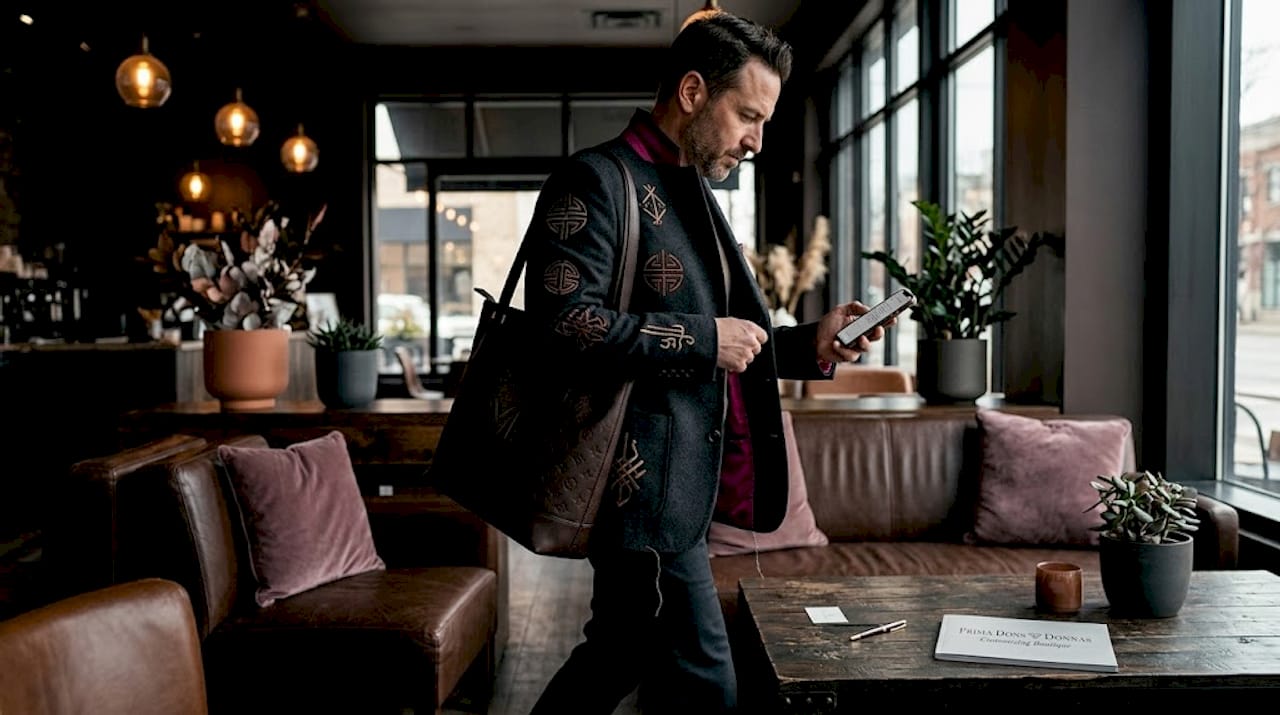
Fashion choices also carry political weight beyond aesthetics. What you reclaim through dress, whether cultural heritage, body positivity, or gender expression, is not just personal. It’s social.
The existentialist case for building your style
Most style advice tells you to “find your aesthetic.” Existentialism disagrees with that framing entirely, and the disagreement is worth understanding.
Jean-Paul Sartre’s principle “existence precedes essence” applied to fashion means there is no fixed inner self waiting to be revealed through the right outfit. You are not discovering your style. You are building your identity through every clothing choice you make. That is a meaningful distinction.
“Authenticity in fashion comes less from being ‘true’ to a fixed self and more from consciously choosing who to be.” — Sartorial existentialism in fashion
This view removes a lot of pressure. You are not failing at self-expression when your style changes. You are not betraying your “real self” when you try something new. The person who wore grunge at 22 and wears tailored blazers at 38 has not become inauthentic. They have become someone different, which is exactly what life requires.
True fashion individualism adapts as your internal states and life circumstances shift. Forcing a rigid “signature look” can actually inhibit identity growth because it treats style like a locked box rather than a living practice. The existentialist approach gives you permission to evolve, and that is where style longevity actually comes from.
The practical implication: invest in pieces you genuinely connect with right now. Not pieces that signal who you wish you were or who you used to be. Clothes that fit the life you are currently living, including how your body exists in that life, are always the most honest wardrobe choices.
Putting fashion individualism into practice
Understanding the concept is one thing. Applying it to actual shopping and dressing decisions is another. Here is how to build personal style that reflects real fashion individualism.
- Start with occasions, not aesthetics. Think about the actual events that fill your life: concerts, lunch dates, weddings, work events, casual Saturdays. Dress for the real version of your life, not a curated fantasy of it.
- Use trends as ingredients, not recipes. Trends in personal fashion are rising in 2026 toward bold graphic prints and tactile materials, with interest in print-led statement pieces up 147% in Q4 2025. Pull from what genuinely excites you and leave the rest.
- Customize where it counts. Generic sizing and color options rarely reflect the full range of how real people are built. Made-to-order pieces fit your body instead of asking your body to fit the clothes. This is especially true for plus-size shoppers who deserve options that are designed for them, not scaled up from a sample size.
- Think about personal style building as a long game. One statement piece in a wardrobe of clothes you actually wear beats five impulse purchases that never make it out of the closet.
- Resist the urge to shop algorithmically. Consumers are actively moving away from fast fashion cycles and toward slower, more intentional approaches: thrifting, customization, and pieces with personal meaning.
For special occasions specifically, the pressure to wear something impressive often overrides the preference for something personal. A custom dress for a wedding, a bold jacket for a concert, a fitted look for a birthday dinner. These are the moments where fashion individualism matters most because the outfit becomes part of the memory.
Pro Tip: For any event where you want to feel genuinely yourself, choose one piece that is custom or highly specific to your taste and build the rest of the outfit around it. That anchor piece does the identity work. Everything else just supports it.
Checking out types of custom fashion can also give you a clear framework for where personalization adds the most value across different garment categories.
Approaches to fashion individualism compared
Not everyone expresses fashion individualism the same way. Here is a straightforward breakdown of the most common approaches and what each one actually delivers.
| Approach | What it looks like | Strengths | Weaknesses |
|---|---|---|---|
| Trend-averse individualism | Avoiding mainstream fashion entirely | Strong personal identity signal | Can become its own rigid uniform |
| Trend-influenced individualism | Selectively adopting trends that fit personal values | Flexible and socially fluent | Requires self-awareness to avoid over-following |
| Performative uniqueness | Dressing to signal “I’m different” | High visual impact | Often results in the individuality complex |
| Existential becoming | Evolving style based on current identity | Authentic and sustainable long-term | Requires ongoing self-reflection |
| Custom and personalized | Made-to-order or heavily customized pieces | Best fit for body and identity | Higher investment of time or money |
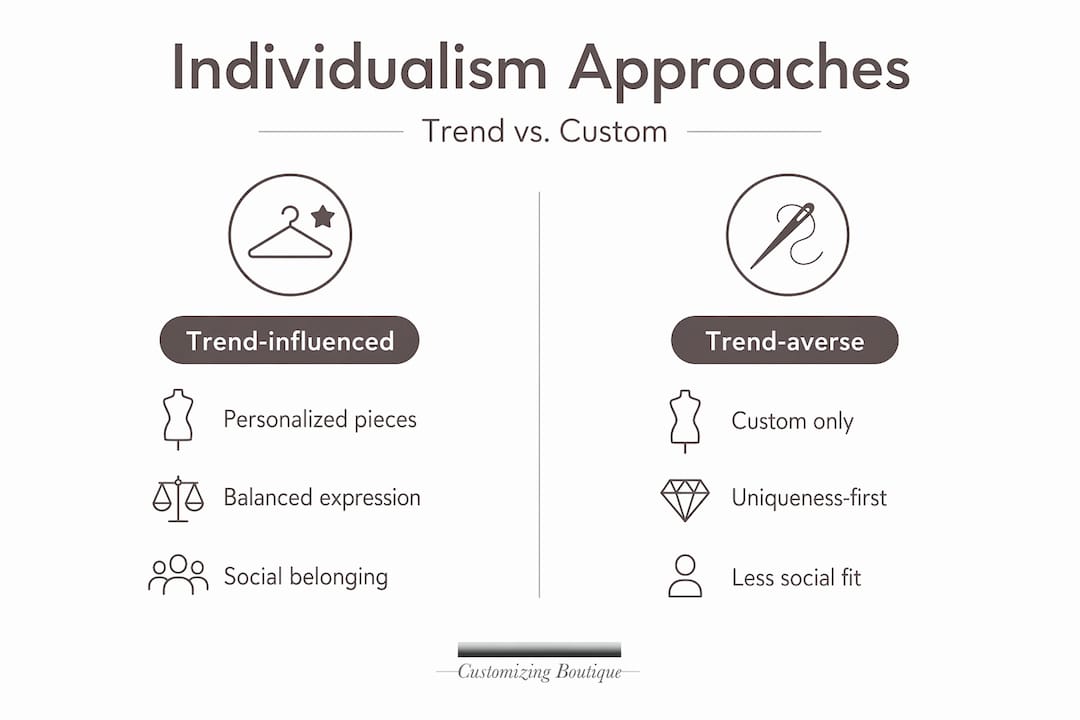
The most effective approach for most people combines trend-influenced individualism with custom or personalized pieces for moments that matter. You stay socially connected through shared style references while carving out genuine distinction through pieces built specifically for you.
My take on fashion individualism
I’ve watched people tie themselves in knots trying to be “authentically themselves” through fashion, and what I’ve found is that the pressure to have a singular, consistent aesthetic is the biggest obstacle to actual individual style.
In my experience, the people with the most compelling personal style are not the ones who reject trends hardest. They are the ones who pick up trends selectively, mix them with custom or vintage pieces, and show up differently at a concert than they do at a lunch date without feeling like they’ve contradicted themselves. Their style tells a story with chapters, not a single repeated sentence.
What I’ve also learned is that size inclusivity and occasion-specific dressing are where fashion individualism gets practical fast. If you’re shopping plus-size or need something specific for a wedding, a party, or a special event, generic options strip out the individuality before you even start. Custom pieces built to your size and color preferences put the decision-making back where it belongs: with you.
My take is simple. Stop trying to find your style and start building it. Buy what fits your life right now. Let it change when your life changes. Fashion is a dynamic story you keep writing, not a fixed answer you arrive at once.
— Latoya
Build your look with Primadonsanddonnas
If the principles above resonate, Primadonsanddonnas makes the practical side straightforward. Every piece in the collection is designed to support real fashion individualism, not just the idea of it.
The made-to-order dress collection covers everything from party events and concert outfits to wedding apparel, with custom sizing available in every color. Plus-size options are built into the process, not added as an afterthought. For outerwear that makes a statement, the custom outerwear collection includes faux fur jackets and bold coats tailored to your specifications. Need something fast? Ready-to-ship options are available for quick delivery. Shop the full range at primadonsanddonnas.com.
FAQ
What is fashion individualism in simple terms?
Fashion individualism is the practice of making clothing choices based on personal identity and values rather than following trends for their own sake. It balances uniqueness with social belonging rather than rejecting all mainstream influence.
Is fashion individualism the same as avoiding trends?
No. Avoiding trends entirely often creates its own form of conformity. Fashion individualism means engaging with trends selectively and thoughtfully, choosing what genuinely fits your identity and leaving the rest.
Why does unique fashion sometimes look the same as everyone else’s?
This is the individuality complex. When nonconformist styles get widely adopted and mass-produced, they lose their distinctiveness. Ripped jeans and visible tattoos both started as countercultural signals before becoming mainstream staples.
How does plus-size fashion connect to individualism?
Custom and inclusive sizing are central to fashion individualism because clothes built for your actual body give you far more control over how your identity is expressed. Generic sizing limits options in ways that make genuine personalization harder.
How do I start building a more individual personal style?
Start with your real life occasions and identify one or two pieces that feel genuinely connected to your identity. Add custom or made-to-order options for events that matter most, and let your style evolve as you do rather than locking it into a fixed aesthetic.
Recommended
- Fashion Individuality Explained: Making Style Personal – Prima Dons & Donnas
- Why Personalized Fashion Matters for Modern Women – Prima Dons & Donnas
- Role of Personalization in Fashion: Defining Unique Style – Prima Dons & Donnas
- Why Fashion Reflects Individuality in Modern Style – Prima Dons & Donnas


Leave a comment