

Your essential guide to custom fashion sizing for a perfect fit
TL;DR:
- Standard sizing is based on averages and varies widely by brand and country, often leading to poor fit.
- Custom sizing uses individual measurements and fit processes to create garments that better match your body.
- Digital tools and ongoing measurement updates improve fit accuracy, reduce waste, and support sustainable fashion.
Standard clothing sizes were never designed to fit every body. They were built around statistical averages, and most women fall somewhere between those numbers. That gap between the chart and reality is where frustration lives. Sizing varies by brand and even by country, meaning a size 10 in one store is a size 12 in another. Custom sizing closes that gap by mapping your actual measurements to how a garment is built. This guide explains how custom sizing works, why it matters, and exactly how to use it to get clothes that fit your body, not a spreadsheet.
Table of Contents
- Why custom sizing beats standard charts
- How custom sizing is created: Behind the scenes
- How to measure yourself for custom fashion
- Digital fit tools: The future of custom sizing
- Our perspective: What really works for a perfect fit
- Discover your perfect fit with Prima Dons & Donnas
- Frequently asked questions
Key Takeaways
| Point | Details |
|---|---|
| Fit is personal | Custom sizing adapts garments to your actual body, delivering superior comfort and style. |
| Standard sizes are inconsistent | Brand and country-based variations make standard sizes unreliable for most shoppers. |
| Measuring is crucial | Taking precise measurements is the first step to achieving perfect custom fits. |
| Tech enhances sustainability | Digital fit solutions help you get your size right and reduce waste from clothing returns. |
Why custom sizing beats standard charts
Walk into any store or scroll through any website, and you will find a sizing chart. It looks official. It feels like a solution. But most women already know from experience that following the chart does not guarantee the clothes will actually fit.
The core issue is that no universal size system exists across brands or borders. A brand based in the U.S. may use entirely different measurements than a European label, even if both call the garment a “medium.” Even within the same country, one brand’s size 8 can be dramatically different from another’s. The chart is a starting point, not a promise.
Beyond brand inconsistency, there’s a deeper problem. Standard sizes are designed to target the average body shape in a given population. But body shapes vary in countless ways. You might have a smaller waist relative to your hips, or broader shoulders than a standard size accounts for, or a longer torso. All of those differences are real, and none of them mean anything is wrong with your body. They simply mean a standard size was not designed with you in mind.
Custom sizing flips that logic. Instead of asking your body to match a garment’s chart, it builds the garment around your measurements. That shift, small as it sounds, changes everything about how clothing feels and looks. Women who experience size inclusivity and confidence through custom-fit fashion consistently describe the difference as significant.
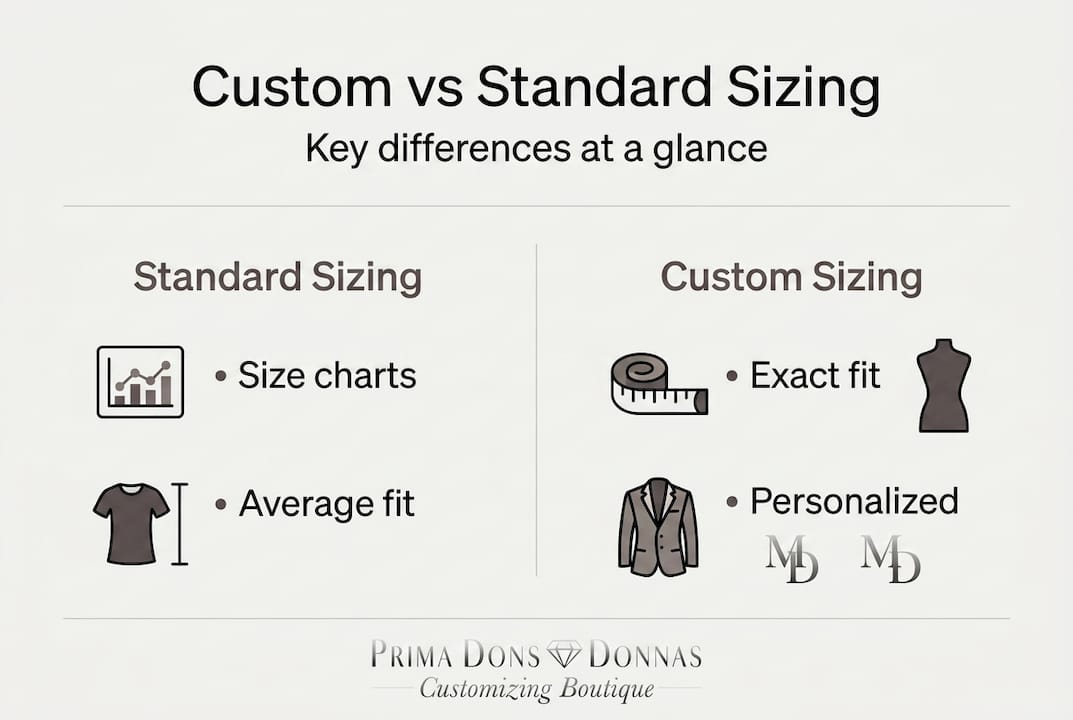
Here’s a comparison of standard sizing versus custom sizing across key factors:
| Factor | Standard sizing | Custom sizing |
|---|---|---|
| Based on | Population averages | Your actual measurements |
| Consistency | Varies by brand and country | Specific to your body |
| Fit accuracy | Low to moderate | High |
| Style flexibility | Limited to stock options | Color, size, style adjustable |
| Sustainability | More returns and waste | Fewer returns, less waste |
Beyond the numbers, here’s what standard sizing consistently fails to deliver:
- Bust-to-waist ratio variations are ignored in most size charts
- Hip-to-waist proportions are averaged, leaving curvy silhouettes underserved
- Petite and tall frames require length adjustments most charts do not address
- Plus-size proportions are often just scaled-up standard patterns, not re-engineered fits
- Shoulder width is rarely listed at all, despite being critical for tops and outerwear
“The goal of custom sizing is not just a better number on a tag. It’s a garment that moves with your body, flatters your proportions, and gives you the confidence to wear it exactly as intended.”
The bottom line is simple. If standard charts worked perfectly, returns would not be such a widespread issue in fashion retail. Custom sizing exists because it provides a more accurate, more respectful path to fit.
How custom sizing is created: Behind the scenes
Understanding how custom sizing is engineered helps you ask better questions, work more effectively with tailors, and shop smarter. The process is more technical than most people realize.
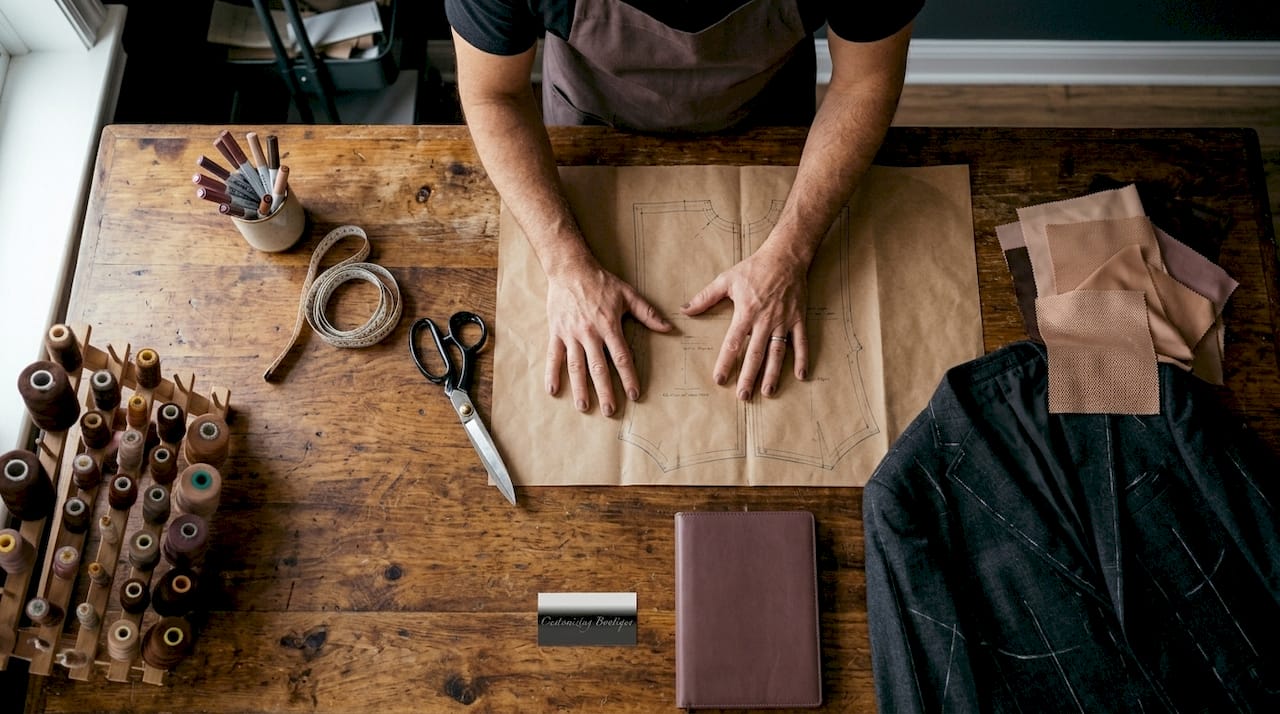
It starts with size grading, which is the process of scaling a base pattern across multiple size points using what are called grade rules. A grade rule is a set of measurements that defines how much each part of a pattern grows or shrinks between sizes. For example, the side seam might increase by a specific amount per size, while the neckline adjustment might follow a different rule entirely. Done well, size grading preserves the proportions of the original design across all sizes. Done poorly, it simply stretches everything uniformly, which distorts the fit.
After grading, brands rely heavily on fit models and fit sessions. A fit model is a person whose measurements closely match the brand’s target customer profile. Prototypes are tested on fit models at multiple stages of production. Designers and pattern makers assess how the garment moves, where it pulls, whether it bunches, and how it looks from every angle. The pattern is then adjusted based on those real-world observations.
Key points of measurement (POMs) that are tracked across size changes typically include:
- Chest or bust circumference
- Waist circumference
- Hip circumference
- Shoulder width
- Front and back bodice length
- Sleeve length and width at key points
- Inseam and outseam length
- Neck circumference
Each of these POMs has a corresponding grade rule, and small errors at any point multiply across the full size range. This is why custom sizing, which maps your individual measurements directly to a garment, produces dramatically better results than relying on a mass-produced pattern.
Pro Tip: When working with a tailor for a custom order, ask specifically about their grade rules for the garment style you want. Understanding whether they grade from a base size up or build fresh from your measurements helps you know how closely the final piece will match your body.
For a detailed walkthrough of the process you can follow at home, the custom measurement guide breaks everything down step by step.
Here’s a reference table showing typical POM categories and their role in custom fit:
| Point of measurement | Why it matters |
|---|---|
| Bust | Foundation for tops, dresses, and outerwear |
| Waist | Key for structure and silhouette definition |
| Hips | Critical for skirts, pants, and dresses |
| Shoulder width | Determines how a garment sits and frames the upper body |
| Sleeve length | Affects sleeve and jacket fit dramatically |
| Inseam | Sets the length for pants and overalls |
| Back length | Controls hem and waist placement on dresses |
How to measure yourself for custom fashion
Knowing how custom sizing is built is only half the work. The other half is giving a brand or tailor accurate measurements to work from. Inaccurate measurements lead to inaccurate fits, no matter how skilled the pattern maker.
Start with the right tools. A flexible measuring tape, a mirror or a trusted friend, and a form-fitting outfit or your undergarments will give you the clearest results. Avoid measuring over thick or structured clothing, since that adds bulk that will not reflect in the final fit.
Here are the essential measurements to take, in order:
- Bust. Wrap the tape around the fullest part of your chest, keeping it parallel to the floor. Do not pull it tight; it should lie flat without digging in.
- Waist. Measure around your natural waist, which is the narrowest point of your torso, usually about an inch above your belly button. Stand relaxed, do not suck in.
- Hips. Measure around the fullest part of your hips, typically about 7 to 9 inches below your natural waist.
- Inseam. Measure from your crotch down to the floor along the inside of your leg. This is easiest with a friend’s help.
- Shoulder width. Measure from the edge of one shoulder across the back to the edge of the other.
- Sleeve length. Bend your arm slightly and measure from your shoulder point down to your wrist.
- Back length. Measure from the top of your spine down to where you want the garment to end.
Common mistakes women make when taking measurements include letting the tape sag at the back (which understates the measurement), measuring over padded bras (which overstates the bust), and measuring while standing stiffly (which changes the reading at the waist and hips). Garment fit sessions at professional brands account for natural posture and movement, so try to mimic that ease when you measure at home.
Pro Tip: Take your measurements at two different times of day. Bodies naturally shift slightly throughout the day due to hydration and posture. Averaging two readings gives you a more reliable number to submit.
For a full walkthrough with visuals and guidance on common body types, check out how to measure for custom fashion and the dedicated resource on measuring for made-to-order clothing.
One more important note: update your measurements every three to six months. Bodies change with seasons, fitness routines, and life stages. A measurement set from two years ago may not give you the accurate fit you expect today.
Digital fit tools: The future of custom sizing
The fashion industry has been investing heavily in technology to solve the fit problem at scale. Digital fit tools are changing how brands approach sizing and how you, as a shopper, can navigate the process more confidently.
Fit analytics and 3D virtual simulation are two of the most impactful technologies in this space. Fit analytics platforms use your entered measurements combined with purchase history and return data to recommend sizes with higher accuracy. Some platforms learn over time, refining their recommendations based on what actually fit different body types. Virtual 3D simulation, on the other hand, lets brands or retailers render how a garment will look and move on a digital representation of your body before you buy.
These tools serve a sustainability function as well. Returns in fashion are a major source of waste, involving repackaging, shipping, and in many cases disposal of garments that cannot be resold. When digital tools reduce return rates even moderately, the environmental impact across thousands of orders is significant.
Here’s what digital fit tools currently offer:
- Virtual try-on apps that overlay garments on your photo or 3D body scan
- Body scanning kiosks found in select retail locations that capture precise measurements in seconds
- AI-powered size recommendations based on your measurements and brand-specific data
- Fit review aggregators that compile how real customers describe the fit of a specific item
- 3D pattern simulation used by brands during design to test fit before producing physical samples
Not every tool delivers equal accuracy. Some virtual try-on apps are more visual than functional, meaning they show you a garment on a model rather than a true simulation of how it would fit your body. Checking independent reviews before relying on a tool’s recommendation is worth the extra time.
Pro Tip: Use digital fit tools as a starting point, not the final answer. Combine any app’s size recommendation with your own measurements and any available customer fit reviews to maximize your chance of getting it right on the first order.
Additional personalized fit tips and size-inclusive shopping tips can help you layer these digital tools into a complete strategy.
Our perspective: What really works for a perfect fit
Here’s the honest truth that most fit guides skip. The perfect size does not exist. There is no magic number on a tag or a chart that solves fit for every garment, every occasion, and every version of your body across your lifetime. Chasing that number is the wrong goal.
What actually works is a mindset shift. Instead of looking for the size that fits, look for the garment built for your measurements. That distinction matters more than people realize. A well-fitted garment at any size feels entirely different from a garment in “your size” that was designed for someone else’s proportions.
We also see a pattern that most guides overlook. Women often update their sizing once or twice and then assume those numbers are permanent. They are not. Your measurements shift with seasons, with fitness changes, with hormonal cycles, and with age. The best-fitted wardrobe belongs to the woman who treats her measurements as a living record, not a fixed file from five years ago.
There is also the question of collaboration. Working with a brand or tailor on ordering custom clothing online is not just about submitting numbers and waiting. It’s about describing how you like things to fit. Do you prefer a relaxed waist? A more structured shoulder? More room through the hips for movement? Those preferences are part of the measurement conversation, and the brands that take them seriously are the ones worth working with.
Finally, fit satisfaction should be about feel, not just visual proportion. A garment that moves with you, stays in place, and lets you focus on your day rather than your clothes, that is a perfect fit. That is the goal.
Discover your perfect fit with Prima Dons & Donnas
Custom sizing should never mean compromise. At Prima Dons & Donnas, every piece is made to your measurements, your color choices, and your style preferences. No more guessing which size to order, no more returns, no more settling.
Explore the made-to-order dress collection for statement dresses cut to your exact specifications. Shop custom outerwear including faux fur coats and jackets sized for your body, not an average. And if footwear has always been a sizing challenge, the custom and plus-size boots collection is built for real calf widths and foot lengths. Ready-to-ship options are also available for when you need a great fit fast. Your measurements, your style, delivered.
Frequently asked questions
What measurements should I take for custom fashion sizing?
Focus on bust, waist, hips, inseam, and sleeve/shoulder length for the most accurate custom fit. These core points of measurement cover the areas most critical to how a garment sits and moves on your body.
Will custom sizing fit better than standard sizes?
Yes, custom sizing is built around your actual measurements rather than population averages. Custom sizing reduces mismatch risk by mapping your body directly to how a garment is patterned.
Do digital fit tools really reduce returns?
Digital fit analytics can meaningfully reduce return rates, though accuracy depends on the specific technology and the quality of data behind it. Pairing tool recommendations with your own measurements gives the best results.
Does custom sizing support sustainable fashion?
Absolutely. Fewer returns means less packaging waste, less shipping, and fewer garments that end up discarded. Digital fit simulation and custom made-to-order production both reduce overstock and unnecessary waste across the supply chain.
Recommended
- How to measure for custom fashion: women’s fit guide – Prima Dons & Donnas
- Why custom sizing matters: fit, style, and sustainability – Prima Dons & Donnas
- Top tips for personalized fit: elevate made-to-order style – Prima Dons & Donnas
- Custom Clothing Measurement Guide for Perfect Fit – Prima Dons & Donnas


Leave a comment